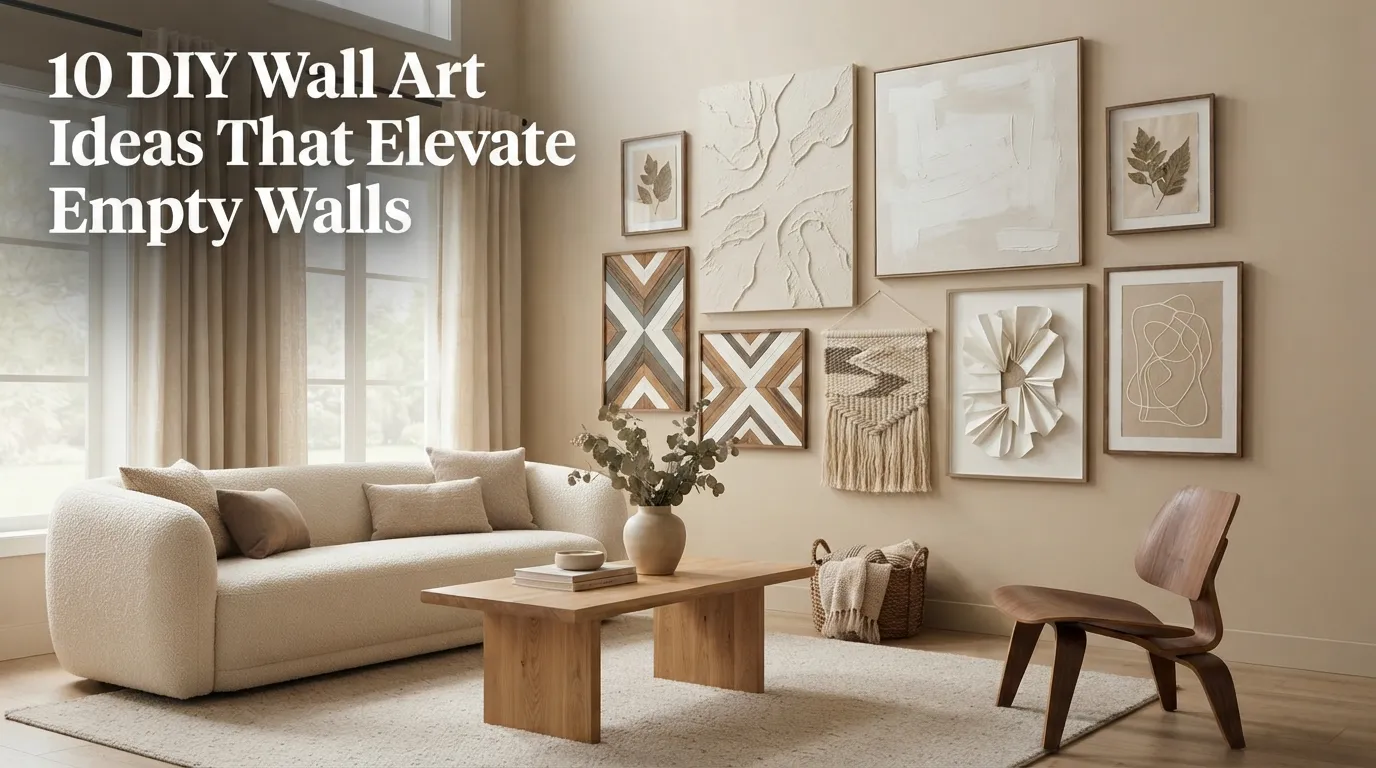
10 DIY Wall Art Ideas That Elevate Empty Walls
Empty walls can make an otherwise beautiful home feel unfinished. The challenge is finding wall art that adds personality without making the room feel crowded, overly coordinated, or expensive.
DIY wall art offers a practical middle ground. You can choose the size, colors, textures, and materials around the room instead of trying to make a ready-made piece work with your existing decor.
I’ve found that the most successful DIY wall art projects don’t necessarily look complicated. A large textured canvas, a collection of framed botanical prints, or a simple painted geometric design can completely change the feeling of a blank wall with relatively little effort.
The key is choosing a project that matches the scale of the wall.
A small artwork can disappear above a large sofa, while an oversized piece can overwhelm a narrow hallway. Color matters, too. Pulling two or three shades from your existing furniture, rug, curtains, or accessories can make handmade art feel intentionally connected to the room.
Texture is another easy way to create visual interest. Canvas, plaster-look finishes, fabric, wood, paper, and natural fibers can add dimension without requiring complicated artistic skills.
These projects also work across different decorating styles. A neutral abstract canvas can complement modern interiors, while pressed botanicals can suit a cottage-inspired room. Painted arches can soften a minimalist space, and reclaimed wood can bring warmth to a contemporary wall.
Whether you’re decorating a living room, bedroom, hallway, office, or rental, these ten DIY wall art ideas offer approachable ways to turn empty walls into meaningful focal points.
Table of Contents
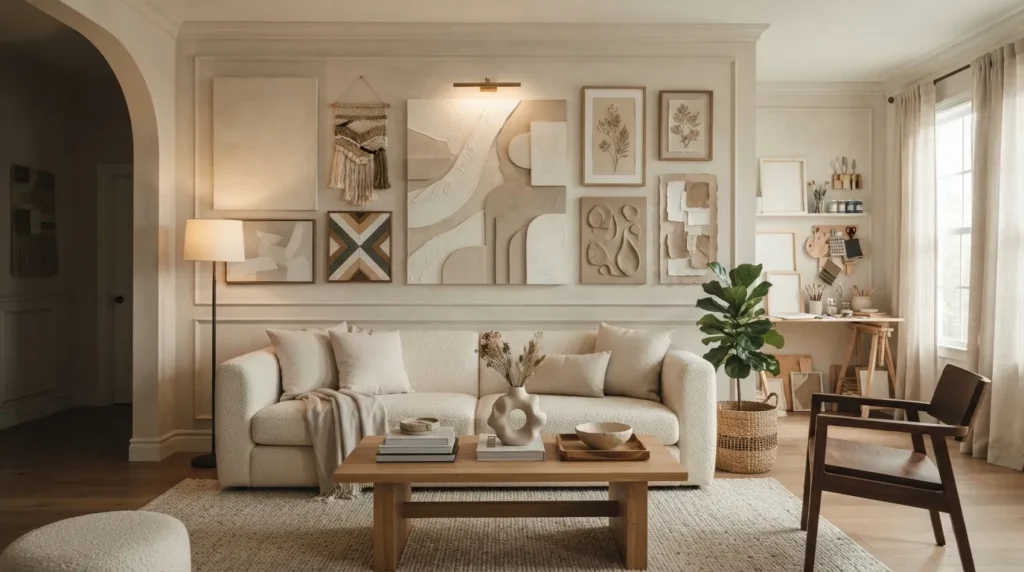
1. Textured Canvas Art
Create dimensional artwork with simple layers of texture and neutral color.
2. Oversized Abstract Painting
Fill a large wall with an expressive handmade composition.
3. Framed Botanical Art
Bring natural shapes and greenery-inspired details indoors.
4. Painted Arch Panels
Use simple curved shapes to create soft architectural interest.
5. Fabric Wall Hanging
Add warmth and softness with an easy textile-based artwork.
6. DIY Gallery Wall
Combine personal images and coordinated artwork into one display.
7. Geometric Canvas Art
Create clean visual patterns with basic painter’s tape.
8. Reclaimed Wood Artwork
Add natural texture and character with simple wooden pieces.
9. Paper Flower Display
Build dimensional floral art that creates a playful focal point.
10. Minimal Line Art
Create understated artwork with simple continuous lines.
1. Textured Canvas Art
Quick Benefits
- Adds dimension to blank walls
- Works with neutral interiors
- Requires simple materials
- Can be customized to any size
- Creates a sophisticated handmade look
Why It Works
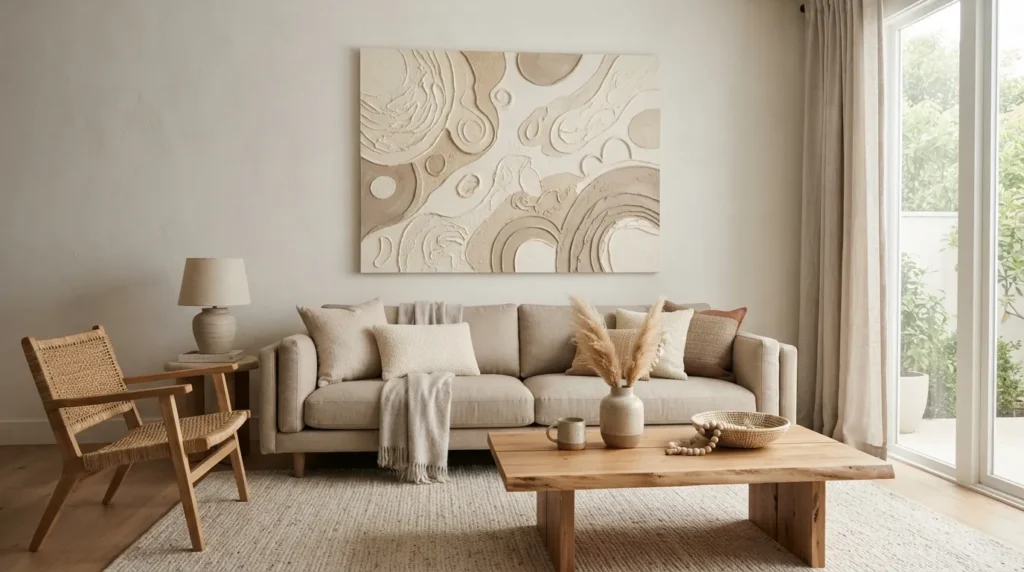
Textured canvas art is one of the easiest ways to make a blank wall feel intentional.
Instead of relying on complex painting techniques, the artwork gets its character from raised texture. Joint compound, modeling paste, plaster-style mediums, or other suitable art materials can create subtle ridges, curves, waves, and abstract forms.
Neutral shades make this approach especially versatile.
Cream, ivory, beige, taupe, warm gray, and soft white can create a calm piece that works alongside existing furniture without introducing another strong color.
The texture catches natural and artificial light differently throughout the day, giving the wall more visual depth.
How To Style It
Start with a stretched canvas in a size appropriate for the wall.
Apply your chosen texture medium using a palette knife, scraper, brush, or another suitable tool.
Try simple organic patterns rather than attempting to create a highly detailed image.
Once dry, paint the entire canvas in one neutral shade or layer two closely related tones.
For a large sofa, an oversized horizontal canvas can work particularly well.
For a narrow wall, use a vertical composition.
Place the finished piece in a simple frame or leave the canvas edges exposed for a more contemporary appearance.
2. Oversized Abstract Painting
Quick Benefits
- Fills large walls effectively
- Creates an immediate focal point
- Allows personal expression
- Can coordinate with existing colors
- Works in many decorating styles
Why It Works
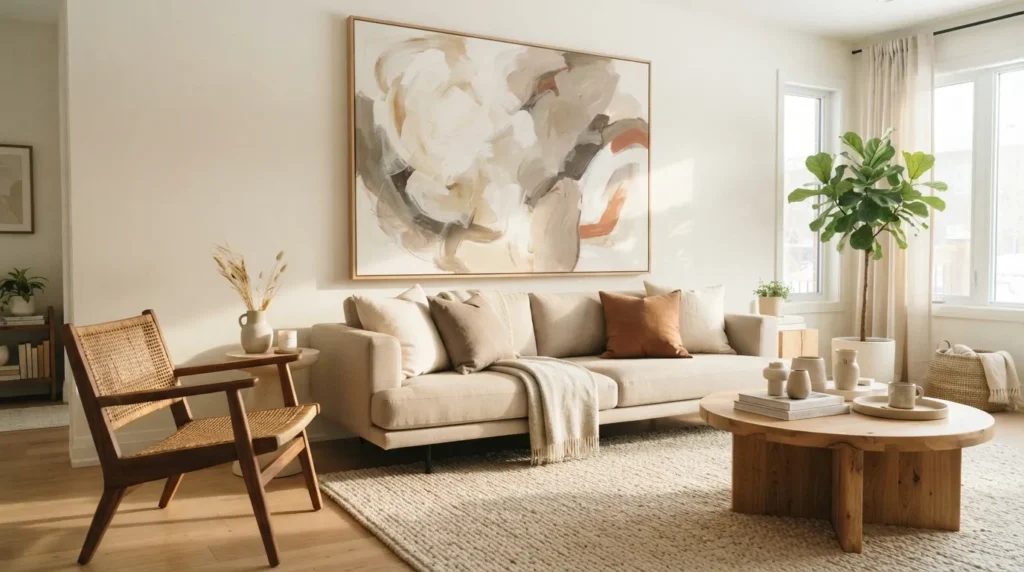
Large walls often need artwork with enough visual weight to feel proportional.
An oversized abstract painting solves that problem without requiring a detailed artistic subject.
The beauty of abstract work is that there isn’t one correct composition.
You can build the artwork around broad shapes, loose brushstrokes, layered colors, or soft blocks of tone.
This makes the project accessible even if you don’t consider yourself an artist.
The most important consideration is scale.
One substantial piece can look more polished than several small pieces scattered across a large wall.
How To Style It
Choose three to five colors already present in the room.
Start with the lightest shade as a base.
Add large shapes before introducing smaller marks.
Step back frequently while working.
This helps you judge the composition from the distance at which the artwork will actually be viewed.
For a modern home, consider warm neutrals with one muted accent.
For a colorful room, repeat one or two existing tones.
Use a large frame if the wall needs more architectural definition.
3. Framed Botanical Art
Quick Benefits
- Brings nature indoors
- Works with neutral decor
- Creates a collected appearance
- Easy to arrange in groups
- Suits bedrooms, offices, and hallways
Why It Works
Botanical artwork brings organic shapes to walls without requiring bold colors.
Leaves, branches, grasses, flowers, and seed pods provide natural forms that can soften rooms filled with straight furniture lines.
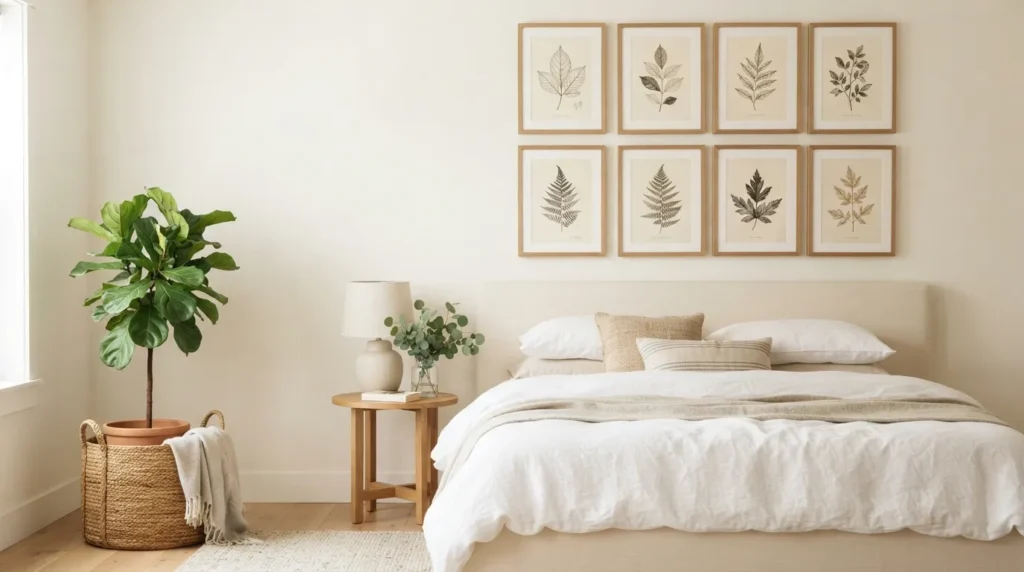
You can create botanical art using pressed plants, handmade illustrations, botanical-inspired sketches, or high-quality prints arranged inside your own frames.
A coordinated series often looks more intentional than a single small print.
How To Style It
Choose two or three frame finishes.
Natural wood creates warmth.
Black frames feel more graphic.
Light-colored frames create a softer appearance.
Keep the artwork itself relatively consistent.
For example, use several botanical silhouettes against warm white backgrounds.
Arrange three or four pieces vertically in a hallway.
For a larger wall, create a balanced grid.
Leave consistent spacing between frames.
The repetition gives inexpensive artwork a more polished appearance.
4. Painted Arch Panels
Quick Benefits
- Creates architectural interest
- Uses simple shapes
- Softens straight lines
- Works in minimalist rooms
- Can be painted directly on suitable surfaces
Why It Works
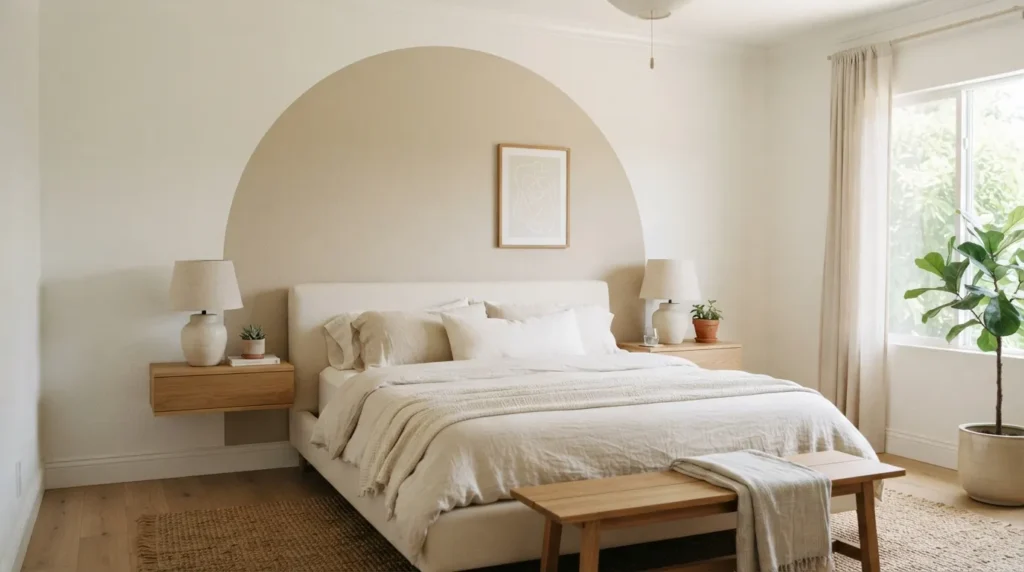
Arched shapes introduce a softer visual rhythm to rooms filled with rectangular furniture and artwork.
A painted arch can function almost like a decorative architectural feature.
The project is particularly useful when you want a large visual statement without hanging a traditional framed picture.
A single oversized arch behind a console table, bed, or reading chair can define the area.
How To Style It
Choose a color that contrasts gently with the wall.
Muted clay, warm beige, olive, dusty blue, and soft terracotta can all create attractive results.
Measure carefully before painting.
Use a level, measuring tape, string, pencil, and suitable painter’s tape or other tools to create a clean shape.
Test the color first because wall lighting can change how it appears.
Keep the furniture in front of the arch relatively simple.
The painted shape becomes the artwork.
For rental homes, use a removable alternative such as a large arched fabric panel or temporary wall covering rather than painting directly on the wall.
5. Fabric Wall Hanging
Quick Benefits
- Adds softness
- Introduces texture
- Absorbs some visual hardness
- Works in bedrooms and living rooms
- Offers many material options
Why It Works
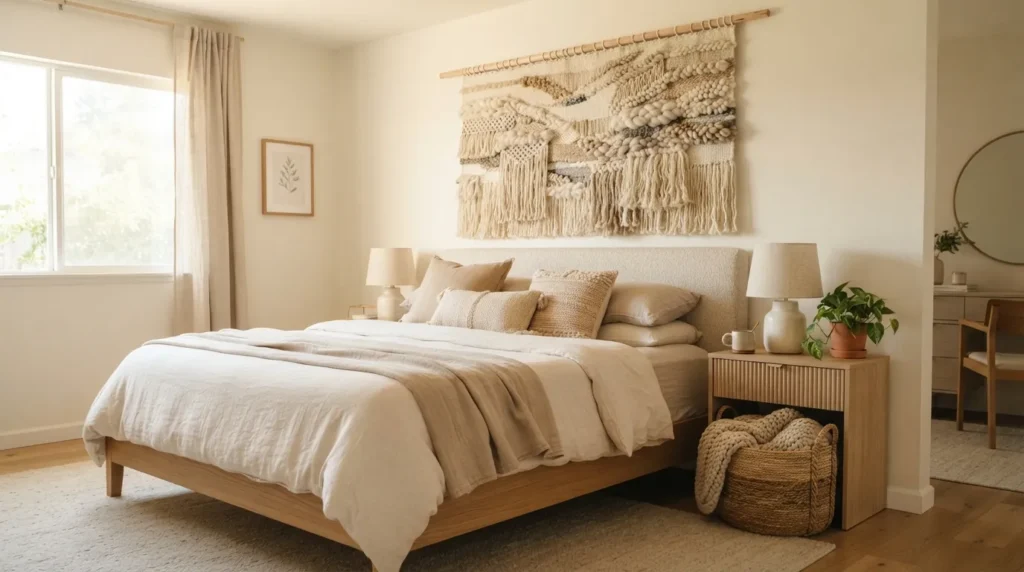
Fabric wall art can make a room feel warmer than traditional framed artwork.
Woven textiles, macramé-inspired designs, linen panels, quilted pieces, and simple fabric banners can add dimension without introducing a glossy or highly polished finish.
This works particularly well in bedrooms because textile artwork naturally complements bedding, upholstered furniture, and soft rugs.
The project can also be customized using colors already present in the room.
How To Style It
Choose a fabric with enough visual weight to hang smoothly.
A simple linen panel can create a minimalist effect.
A woven piece can add more texture.
Wooden dowels can provide a clean hanging structure.
Keep the palette coordinated with nearby textiles.
For a neutral bedroom, combine cream, oatmeal, beige, and natural wood.
For a more colorful space, repeat one accent shade from the bedding or rug.
Avoid hanging delicate fabrics where they can easily collect dust or become damaged.
6. DIY Gallery Wall
Quick Benefits
- Personalizes empty walls
- Uses multiple small pieces
- Works in hallways and living rooms
- Can grow over time
- Offers flexible styling
Why It Works
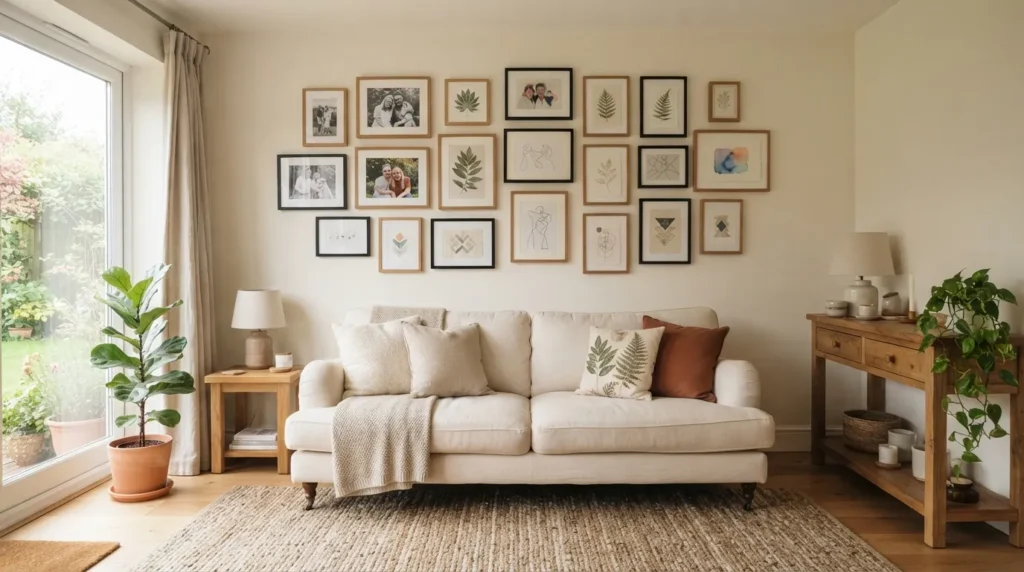
A gallery wall is useful when one large artwork doesn’t suit the space.
It allows you to combine family photographs, sketches, botanical prints, children’s artwork, vintage-inspired illustrations, and handmade pieces.
The trick is creating a visual connection.
The individual pieces don’t have to match exactly.
Similar colors, frame styles, or subject matter can make the collection feel cohesive.
This approach is particularly useful for people who enjoy changing their decor over time.
How To Style It
Begin by choosing a general color palette.
Lay your frames on the floor before hanging anything.
Experiment with different arrangements.
A symmetrical grid feels more formal.
A varied arrangement feels more collected.
Keep the spacing relatively consistent.
Center the overall grouping rather than focusing on the individual frames.
For a living room, consider positioning the gallery wall above a sofa or console.
For a hallway, a vertical sequence can work beautifully.
7. Geometric Canvas Art
Quick Benefits
- Easy beginner project
- Creates clean lines
- Works with modern interiors
- Uses inexpensive materials
- Easy to customize
Why It Works
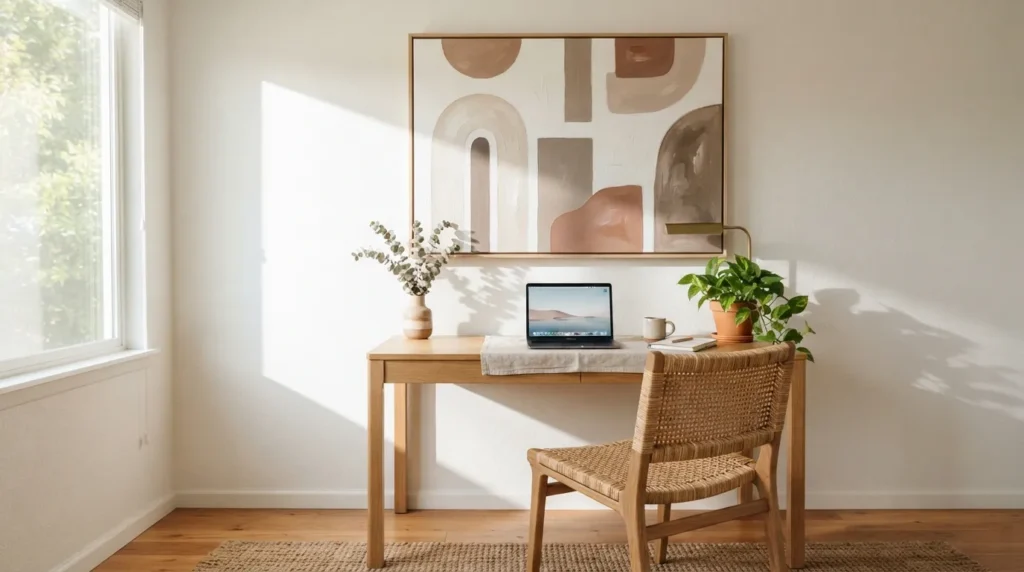
Geometric artwork is a simple way to introduce pattern without buying patterned furniture or wallpaper.
Painter’s tape can create triangles, arches, rectangles, stripes, grids, or overlapping shapes.
The technique doesn’t require advanced painting skills.
It relies mainly on careful preparation and a controlled color palette.
For modern interiors, geometric art can provide just enough structure to balance softer furniture and textiles.
How To Style It
Choose a base color and two or three supporting shades.
Paint the canvas base first and let it dry completely.
Plan your shapes before applying tape.
Press tape edges firmly to reduce paint bleeding.
Work with thin layers rather than applying too much paint at once.
Remove the tape carefully while the paint is still suitable for clean removal according to the paint manufacturer’s directions.
For a sophisticated appearance, use related neutral tones rather than many contrasting colors.
8. Reclaimed Wood Artwork
Quick Benefits
- Adds natural texture
- Introduces warmth
- Works with farmhouse and modern styles
- Uses reclaimed materials
- Creates a substantial focal point
Why It Works
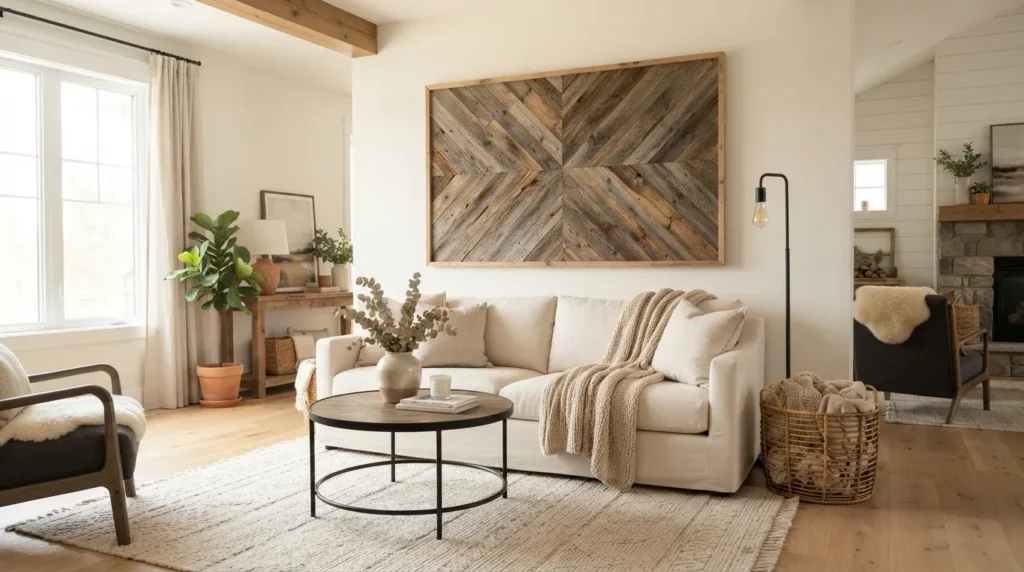
Wood can make a blank wall feel warmer immediately.
Reclaimed boards, leftover trim, wood slices, or unfinished planks can become the foundation for simple handmade artwork.
The natural variation in grain and tone provides visual interest without requiring elaborate decoration.
Wood is especially effective in rooms that already contain natural materials.
It can connect the wall to flooring, furniture, baskets, or exposed architectural elements.
How To Style It
Use clean, structurally sound wood suitable for indoor use.
Sand rough surfaces carefully.
You can leave the wood natural, apply a light stain, or paint selected sections.
Create a simple geometric arrangement with boards.
Another option is to mount several narrow wood pieces vertically or horizontally.
Keep the design relatively simple if the wood grain is strong.
Use appropriate mounting hardware based on the artwork’s weight and the wall structure.
9. Paper Flower Display
Quick Benefits
- Adds dimensional detail
- Creates a playful focal point
- Works in bedrooms and offices
- Offers customizable colors
- Can be made in different sizes
Why It Works
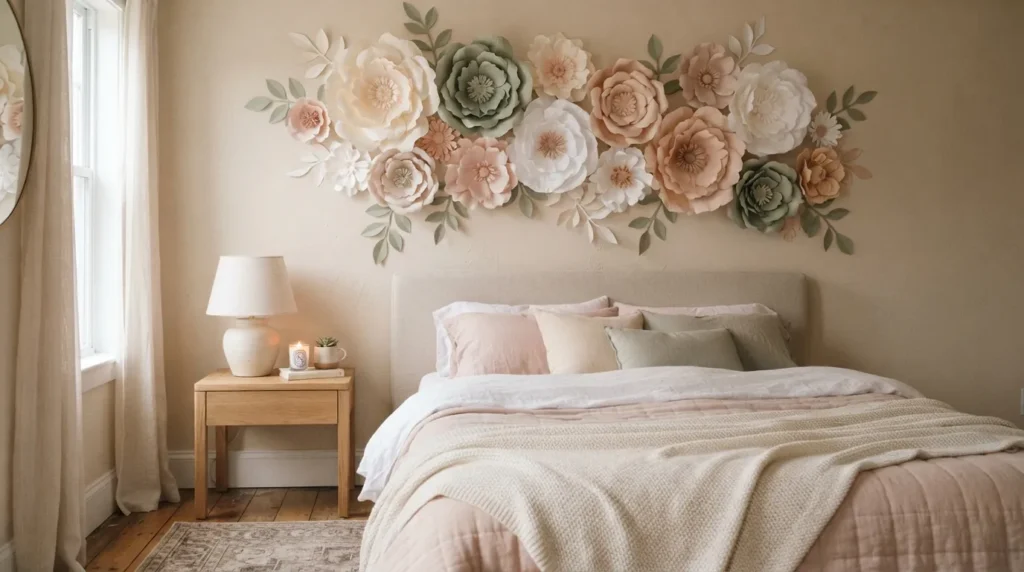
Paper flowers transform flat artwork into a dimensional wall display.
They can be oversized for a dramatic installation or made smaller for a more delicate arrangement.
This idea works particularly well in bedrooms, nurseries, creative spaces, and dressing areas.
Because the flowers are handmade, you can choose the exact colors and shapes to complement the room.
The arrangement can also be changed without replacing an expensive framed artwork.
How To Style It
Choose sturdy paper or cardstock appropriate for the project.
Create flowers in several sizes rather than making every piece identical.
Use a restrained color palette.
Soft blush, cream, white, muted peach, sage, or dusty blue can create a sophisticated appearance.
Arrange the flowers in a flowing cluster rather than a rigid grid.
Mount them securely using suitable removable or permanent methods based on the wall surface.
Keep the arrangement away from moisture and direct heat.
10. Minimal Line Art
Quick Benefits
- Creates a clean appearance
- Requires few materials
- Works with modern decor
- Easy to customize
- Keeps walls visually calm
Why It Works
Sometimes an empty wall doesn’t need a large, complicated artwork.
Simple line art can add personality while maintaining a minimalist atmosphere.
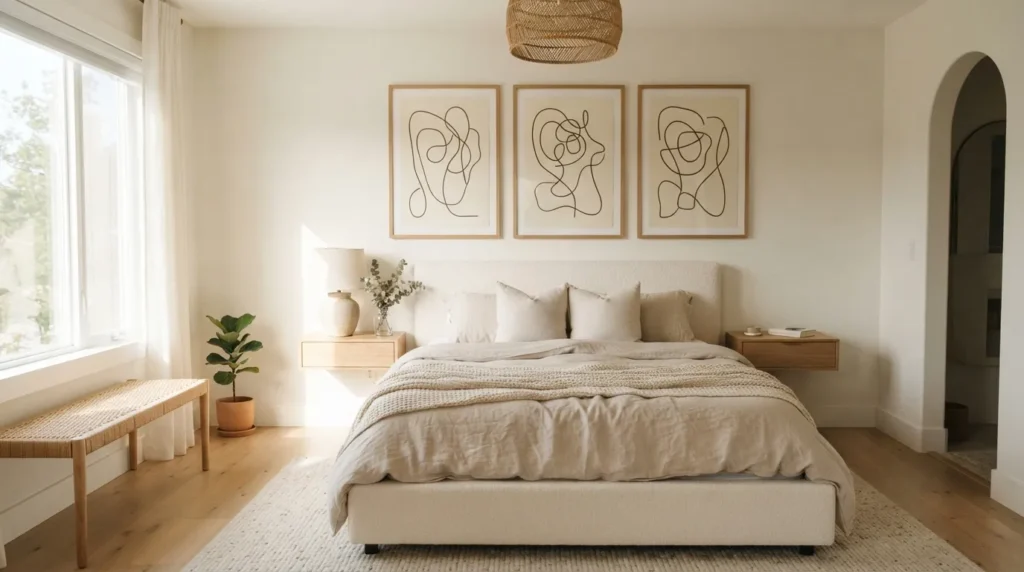
Continuous-line faces, abstract figures, botanical outlines, arches, hands, and organic forms are all possibilities.
The simplicity is what makes the idea versatile.
A single black line on an ivory background can feel sophisticated.
A warm brown line on beige can create a softer appearance.
How To Style It
Start with heavyweight paper or canvas.
Sketch the design lightly before creating the final line.
Use black, charcoal, brown, or another color already present in the room.
Frame the artwork with natural wood or a simple black frame.
For a larger wall, create a set of three related drawings.
Keep the designs connected through line weight, color, or subject.
Avoid adding too many decorative elements around the artwork.
The empty space becomes part of the composition.
How To Choose DIY Wall Art for Your Space
The best project depends on the wall itself.
For Large Walls
Choose oversized abstract paintings, large textured canvases, wood installations, or substantial gallery walls.
For Small Walls
Try line art, botanical prints, small textile pieces, or a compact painted panel.
Above a Sofa
Use one large piece or a carefully proportioned grouping.
Above a Bed
Soft textiles, botanical artwork, oversized neutral canvas art, or simple symmetrical arrangements work well.
For Hallways
Use vertical gallery walls, botanical series, or repeated small artworks.
For Home Offices
Geometric canvases, line drawings, and botanical art can create visual interest without overwhelming the workspace.
How To Make DIY Wall Art Look Expensive
A polished appearance usually comes from presentation rather than expensive materials.
Pay attention to scale.
Artwork that is properly sized for the wall instantly feels more intentional.
Repeat colors.
Use shades already found in the room.
Choose quality frames.
A simple frame with clean proportions can elevate inexpensive artwork.
Leave breathing room.
Don’t fill every inch of the wall.
Use consistent spacing.
This is especially important for gallery walls.
Limit the palette.
Two to four coordinated colors often look more sophisticated than many unrelated shades.
Finish the edges.
Clean canvas edges, smooth wood, and carefully trimmed paper make handmade work look intentional.
DIY Wall Art Materials to Keep on Hand
A small craft supply collection can support many of these projects.
- Stretched canvas
- Acrylic paint
- Paint brushes
- Palette knives
- Textured art medium
- Painter’s tape
- Heavyweight paper
- Cardstock
- Natural wood
- Wooden dowels
- Linen or cotton fabric
- Picture frames
- Measuring tape
- Level
- Pencil
- Appropriate wall mounting hardware
Keep materials organized so simple projects don’t become difficult to start.
Common DIY Wall Art Mistakes
Choosing Artwork That Is Too Small
A tiny piece can disappear on a large wall.
Using Too Many Colors
A handmade project can quickly look disconnected from the room when its palette has no relationship to the surrounding decor.
Hanging Everything Too High
Artwork generally looks better when its placement relates naturally to nearby furniture and the overall room composition.
Overcrowding the Wall
Empty space helps artwork stand out.
Skipping the Planning Stage
Measure the wall and test the arrangement before committing to holes, paint, or permanent installation.
Ignoring the Wall Surface
Painted arches, adhesives, and mounting systems can interact differently with different wall finishes.
Making Every Piece Match
A coordinated collection can still have variation in texture, frame, and subject.
FAQ
What is the easiest DIY wall art for beginners?
Textured canvas, simple line art, and geometric canvas painting are among the most approachable options. They don’t require advanced drawing skills and can be customized to match the room’s colors. Starting with a smaller canvas also makes it easier to experiment before creating a larger piece.
How do I make DIY wall art look expensive?
Focus on scale, color coordination, clean finishing, and presentation. Choose colors already present in the room, use appropriately sized artwork, keep compositions simple, and use quality-looking frames or mounting methods. A restrained design often looks more sophisticated than an overly complicated one.
What can I put on a large empty wall?
Large empty walls can accommodate oversized abstract paintings, textured canvases, large gallery walls, reclaimed wood installations, or multiple coordinated artworks. The artwork generally needs enough visual weight to relate to the wall and nearby furniture.
How do I choose wall art colors?
Start with colors already present in your room. Look at the sofa, rug, curtains, bedding, wood finishes, and accessories. Choose two or three related shades for the artwork. This creates a connection between the handmade piece and the rest of the decor.
Can DIY wall art work in a modern home?
Absolutely. Minimal line art, textured neutral canvases, geometric paintings, painted arches, and simple wood designs can all complement modern interiors. Clean shapes, restrained colors, and natural materials help handmade artwork feel contemporary.
What DIY wall art works best above a sofa?
An oversized canvas, large abstract painting, textured artwork, or balanced gallery wall can work well above a sofa. The artwork generally looks more proportional when its overall width relates to the sofa rather than being a very small isolated piece.
How can renters decorate empty walls?
Renters can use framed art, lightweight fabric wall hangings, removable hanging systems where appropriate, freestanding artwork, and other temporary solutions. Before using adhesives or removable products, check the wall finish and follow the product’s instructions to reduce the risk of damage.
Conclusion
An empty wall is an opportunity to add personality rather than simply a space that needs filling.
DIY wall art makes that process more flexible because you control the colors, dimensions, materials, and overall feeling.
A textured canvas can create quiet sophistication.
An oversized abstract painting can anchor a large living room.
Botanical prints can bring natural shapes indoors.
A fabric hanging can soften a bedroom.
Reclaimed wood can add warmth.
Simple line art can keep a minimalist room feeling calm.
The best project is the one that works with the room you already have.
Before starting, look at the wall from across the room. Consider its size, the furniture below it, the amount of natural light, and the colors already present.
Then choose one project instead of trying to decorate everything at once.
Give the artwork enough space to breathe.
Pay attention to finishing details.
And don’t worry about making your creation look perfectly store-bought.
The small variations that come from making something yourself are part of its charm.
A thoughtfully made piece can turn an overlooked wall into one of the most personal features in your home.
Related Articles
- 10 DIY Wall Art Ideas Using Textured Canvas
- 10 Modern Living Room Ideas with Clean Luxury Style
- 10 Bedroom Wall Decor Ideas with Modern Wood Panels
- 10 Bedroom Wall Decor Ideas That Make a Room Feel Larger
- 10 DIY Home Decor Projects for a More Personal Space