How to Organize a Small Bedroom Without Buying Furniture
A small bedroom can become difficult to organize long before you run out of actual storage space. Clothes collect on chairs, books gather beside the bed, shoes end up on the floor, and everyday items slowly take over every available surface.
The good news is that you don’t necessarily need another dresser, shelving unit, or storage cabinet to regain control.
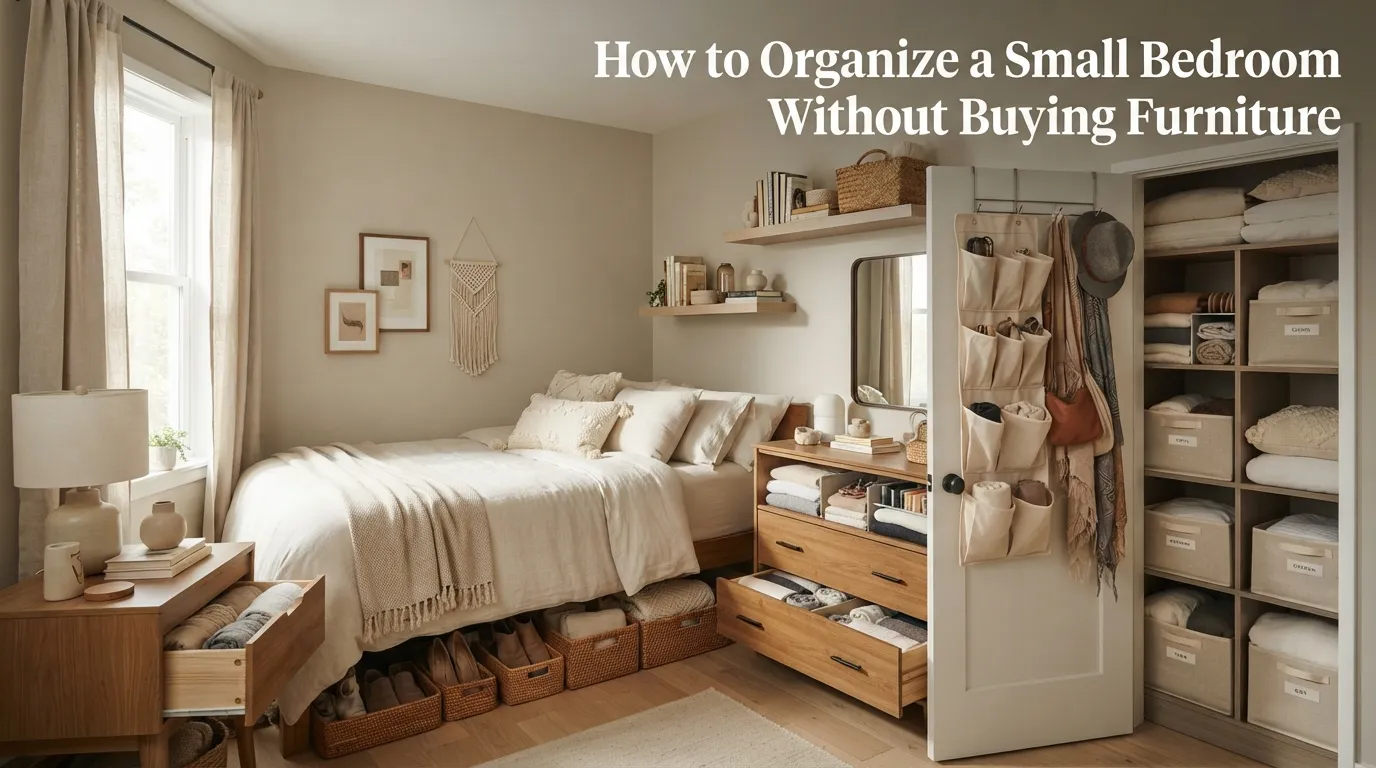
In many small bedrooms, the biggest improvement comes from using the space you already have more intentionally. A better furniture arrangement, vertical storage, hidden spaces, and a few simple organizing habits can create surprisingly more usable room without adding another piece of furniture.
I’ve noticed that one of the most effective approaches is to organize in layers. Start with the floor, then work upward to walls, doors, furniture surfaces, and finally the spaces underneath existing furniture. This helps you discover storage opportunities that are easy to overlook.
Decluttering also matters. If your bedroom contains things you rarely use, no storage solution will make the room feel truly organized. Removing unnecessary items creates breathing room before you even begin rearranging.
You can repurpose boxes, baskets, hooks, jars, bags, and containers you already own. Even something as simple as folding clothes differently or moving seasonal items out of prime-access areas can make daily routines easier.
The ideas below focus on practical organization methods that work especially well for renters, homeowners, college bedrooms, guest rooms, and other compact sleeping spaces.
You won’t need to purchase new furniture. Instead, you’ll learn how to make your existing room work harder while keeping it comfortable, accessible, and visually calm.
Table of Contents
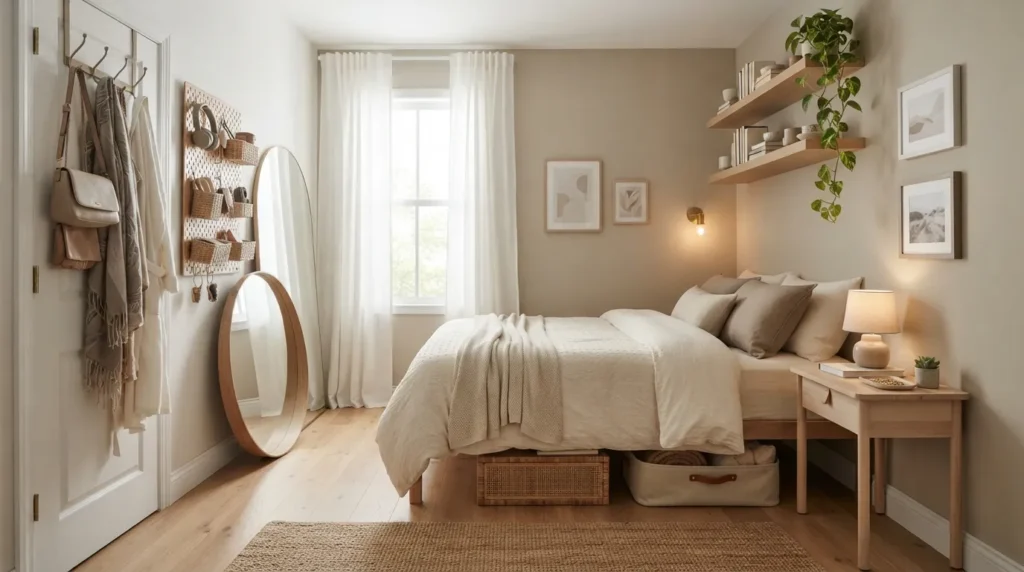
1. Declutter First
Remove unnecessary belongings before deciding where everything should go.
2. Use Vertical Space
Take advantage of walls and other unused vertical areas.
3. Organize Under Bed
Turn overlooked floor space beneath the bed into practical storage.
4. Use Door Space
Transform the back and sides of doors into useful organizing areas.
5. Maximize Closet Space
Rearrange existing closet storage to make more room for everyday items.
6. Rework Furniture Placement
Rearrange what you already own to improve storage and circulation.
7. Create Clothing Zones
Give different categories of clothing dedicated locations.
8. Simplify Surfaces
Reduce visual clutter on dressers, nightstands, and other surfaces.
9. Repurpose Containers
Use household items you already have to contain smaller belongings.
10. Maintain Daily Order
Create simple habits that prevent clutter from returning.
1. Declutter First
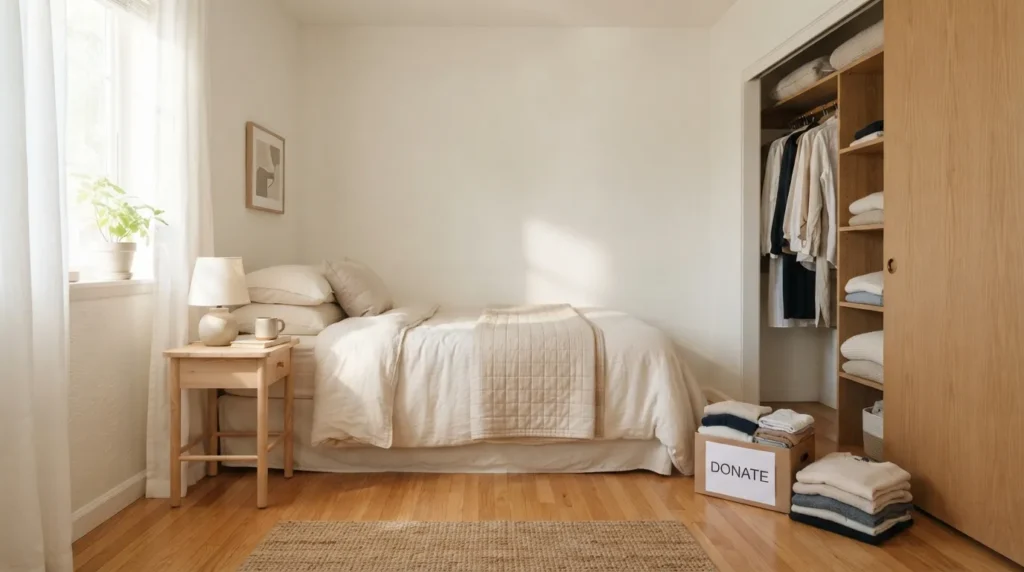
Quick Benefits
- Creates immediate space
- Makes organization easier
- Reduces visual clutter
- Helps identify what you actually use
- Costs nothing
Why It Works
The easiest storage problem to solve is often the one created by belongings you no longer need.
A small bedroom has limited capacity, so keeping rarely used clothing, duplicate items, old paperwork, and forgotten accessories can quickly overwhelm the available space.
Before moving anything, take everything out of one small area at a time.
You don’t need to empty the entire bedroom in one afternoon.
Start with a nightstand drawer, one section of the closet, a clothing pile, or the floor beside the bed.
Separate belongings into categories such as keep, donate, relocate, recycle, and discard.
Be practical rather than perfectionistic.
If you haven’t used something in a long time and it no longer serves a purpose, keeping it may simply create another organizing problem.
How To Style It
Begin with the floor because open floor space immediately makes a small bedroom feel more manageable.
Then move to visible surfaces.
Next, sort clothing.
Finally, tackle drawers and hidden storage.
Keep donation and relocation items in separate bags or boxes so they don’t accidentally return to the bedroom.
Don’t buy organizing containers yet.
Wait until you’ve finished decluttering and know what actually needs to be stored.
This prevents the common mistake of using containers to organize things that could simply be removed.
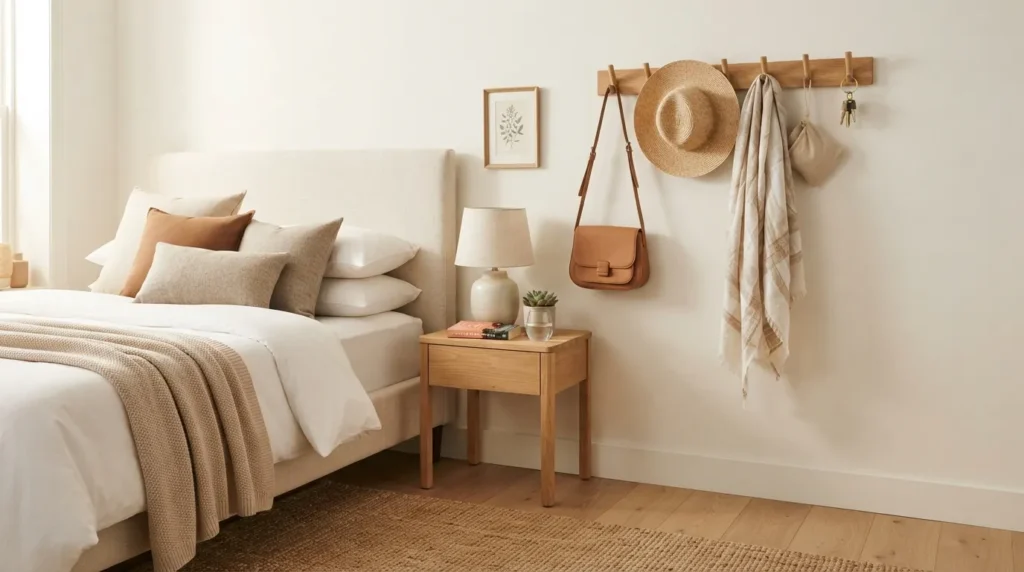
2. Use Vertical Space
Quick Benefits
- Frees valuable floor area
- Makes unused walls useful
- Keeps everyday items accessible
- Creates visual structure
- Works especially well in small rooms
Why It Works
When floor space is limited, look upward.
Walls provide valuable organizing potential without requiring another large piece of furniture.
Existing hooks, pegboards, rails, wall-mounted organizers, or suitable hanging solutions can hold accessories, bags, hats, scarves, jewelry, and other lightweight items.
Even the wall beside a desk or unused corner can become useful.
The key is not turning every wall into storage.
Too many visible items can make the bedroom feel crowded.
Choose one or two vertical zones for belongings you use regularly.
How To Style It
Use existing hooks or wall organizers if you already have them.
Hang frequently used bags near the bedroom entrance.
Keep scarves, hats, or lightweight accessories together rather than scattering them across the room.
If you already own a pegboard or wall-mounted organizer, assign each section a specific category.
Keep the arrangement visually simple.
For rented homes, use removable or property-appropriate hanging solutions when permitted, and follow the manufacturer’s weight limits.
Keep heavier objects on suitable supports rather than improvised hooks.
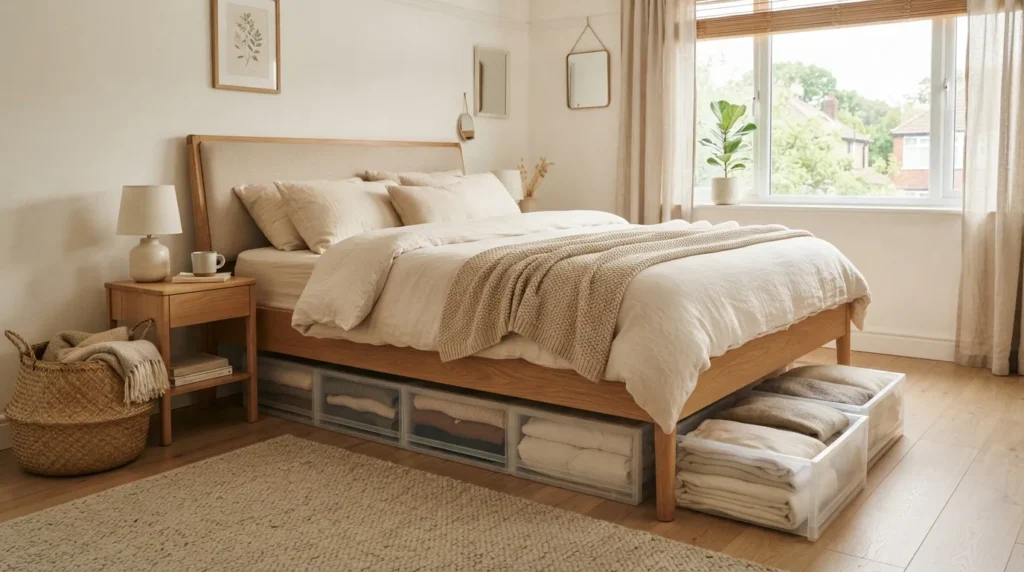
3. Organize Under Bed
Quick Benefits
- Uses hidden space
- Keeps seasonal items out of sight
- Frees closet capacity
- Requires no new furniture
- Keeps the room visually clean
Why It Works
The space underneath a bed is often one of the largest unused storage areas in a small bedroom.
Even a relatively low bed can provide room for flat boxes, soft bags, luggage, folded bedding, or seasonal clothing.
Because this storage remains hidden, it can help keep the room visually calm.
The trick is making sure the area doesn’t become a dumping ground.
If everything is simply pushed underneath the bed, you’ll eventually forget what’s there.
How To Style It
Measure the available height before choosing containers.
Use flat boxes, existing storage bags, suitcases, or sturdy containers that fit comfortably underneath.
Group similar items together.
For example, keep winter clothing in one container and spare bedding in another.
Label containers if you can’t easily see inside them.
Keep frequently used belongings toward the front and rarely used items farther back.
Vacuum or clean the area periodically to prevent dust buildup.
Avoid storing anything that could be damaged by moisture or that requires conditions different from those beneath your bed.
4. Use Door Space
Quick Benefits
- Adds storage without floor space
- Keeps small items accessible
- Makes overlooked areas useful
- Works in bedrooms of many sizes
- Can help organize accessories
Why It Works
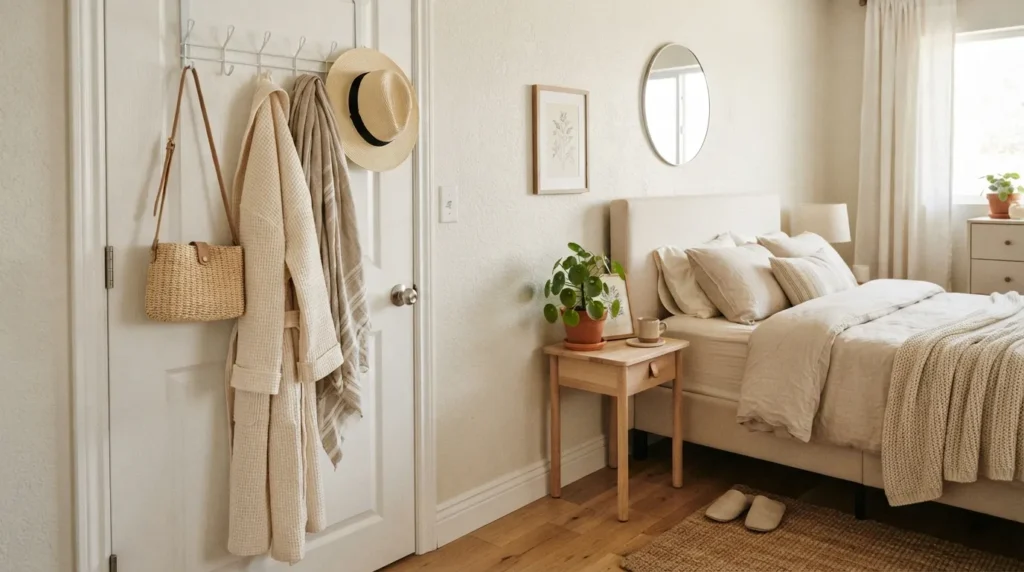
The back of a bedroom door is easy to ignore, yet it provides a vertical surface that can hold many lightweight belongings.
Hooks can hold robes, bags, scarves, hats, or frequently used clothing.
An existing over-the-door organizer can provide compartments for smaller accessories.
This is especially helpful when the bedroom doesn’t have enough wall space for additional organization.
Door storage also keeps everyday items close to where you use them.
How To Style It
Use the door for items that are used frequently.
Keep bags together.
Group accessories into logical categories.
Avoid hanging so many things that the door becomes difficult to open or close.
Check the door’s clearance and the hardware’s weight rating.
If you’re renting, choose an appropriate removable solution if permitted by your lease and the product instructions.
Keep the arrangement tidy by removing items you no longer use.
5. Maximize Closet Space
Quick Benefits
- Creates more usable storage
- Makes clothing easier to find
- Reduces floor piles
- Uses existing furniture
- Improves daily routines
Why It Works
A closet can contain significantly more usable space than it appears to have.
The problem is often not the closet’s size but how the available space is distributed.
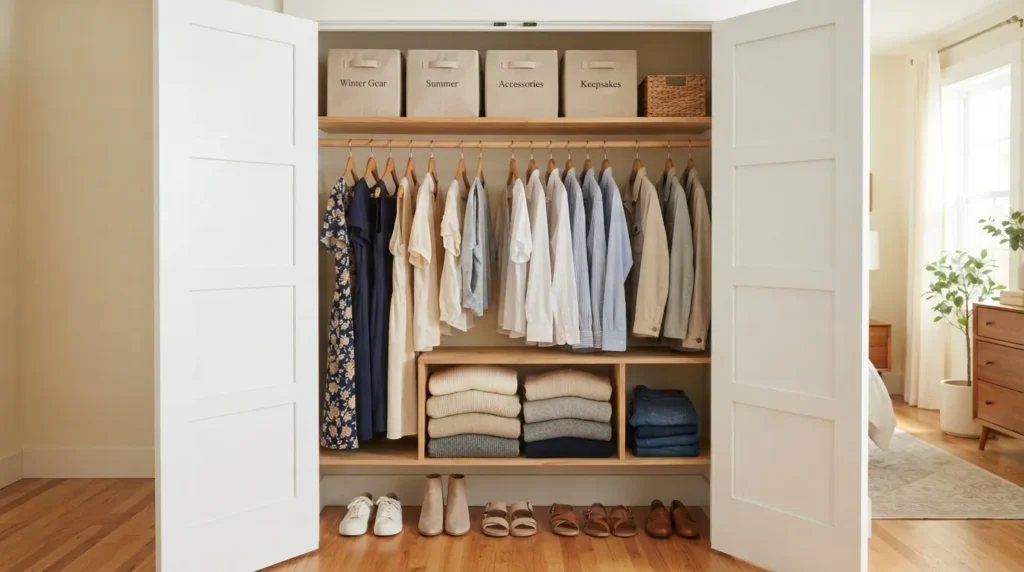
Long-hanging clothing may occupy the entire vertical area beneath it, leaving unused space above shoes, folded items, or shorter garments.
Organizing by category can also reduce the amount of time spent searching.
When everything is mixed together, you tend to pull out several items while looking for one.
How To Style It
Remove everything from one closet section.
Group clothing by category.
Place frequently worn pieces where they’re easiest to reach.
Use the upper areas for less frequently accessed belongings.
Fold bulky sweaters and casual clothing when appropriate rather than hanging everything.
Use suitcases for seasonal clothing or other soft items when they aren’t needed.
If you already own baskets, boxes, or organizers, use them to create categories.
Avoid packing the closet so tightly that clothing becomes difficult to remove.
A little empty space makes the entire closet easier to maintain.
6. Rework Furniture Placement
Quick Benefits
- Costs nothing
- Can improve movement
- Creates more usable floor space
- Makes existing storage easier to access
- Changes the room’s visual balance
Why It Works
Sometimes the problem isn’t a lack of storage.
It’s the way the furniture is arranged.
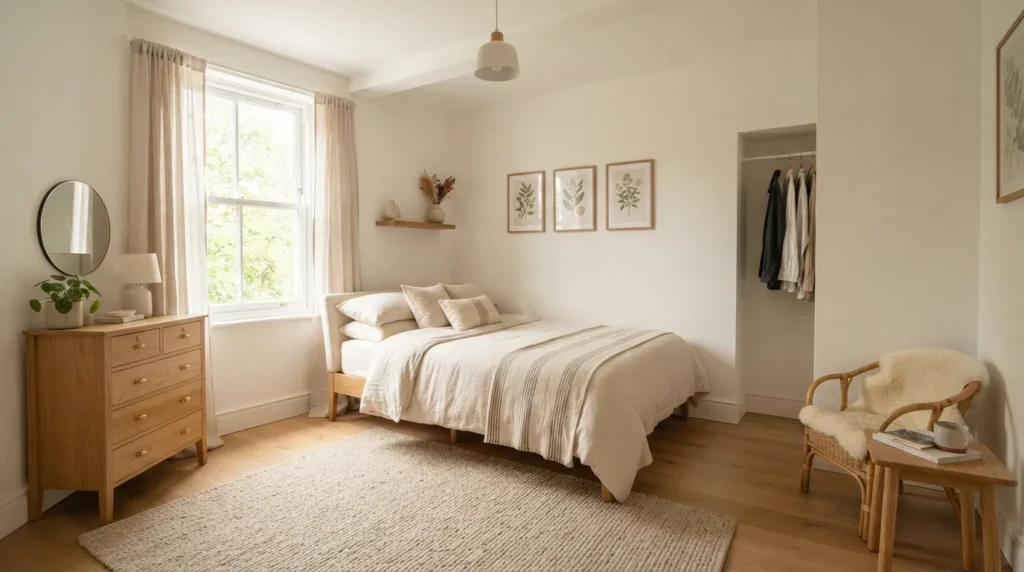
A dresser placed awkwardly can block a corner that could otherwise be useful. A bed positioned too close to a doorway can make the room feel cramped. A chair may become a permanent clothing pile simply because it’s conveniently located.
Before buying anything, experiment with the furniture you already have.
A different arrangement can improve circulation and reveal previously unused areas.
How To Style It
Start by measuring the room.
Then consider the largest piece, usually the bed.
Try positioning it so that walking paths remain clear.
Move the dresser to a wall where drawers can open fully without blocking movement.
If you have a chair that’s consistently covered with clothes, relocate it or give the clothing a different designated home.
Use painter’s tape to mark potential furniture footprints before moving heavy pieces.
Take photos of each arrangement.
Sometimes the camera reveals balance and spacing problems that aren’t obvious in person.
7. Create Clothing Zones
Quick Benefits
- Makes clothes easier to find
- Reduces piles
- Simplifies laundry routines
- Prevents closet confusion
- Encourages consistent organization
Why It Works
Clothing becomes much easier to manage when every category has a predictable home.
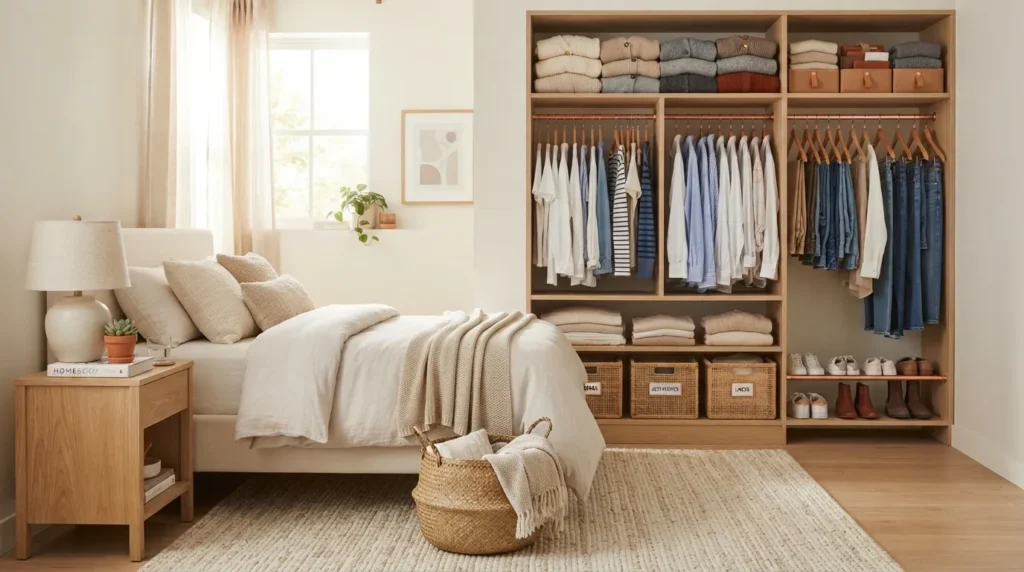
Instead of putting everything wherever space happens to be available, create simple zones.
Everyday tops can have one area.
Pants can occupy another.
Sleepwear can remain together.
Accessories can have their own small container or drawer.
This approach reduces decision-making.
You know exactly where an item belongs when you’re putting laundry away.
How To Style It
Use the storage you already have.
Organize hanging clothes by category or use frequency.
Fold items that don’t need to remain on hangers.
Keep frequently worn clothing at eye level.
Place seasonal pieces in less accessible areas.
Use existing boxes for accessories.
If you have a suitcase that isn’t regularly used, use its interior for seasonal soft goods.
Avoid creating so many categories that organizing becomes complicated.
Simple systems are more likely to last.
8. Simplify Surfaces
Quick Benefits
- Makes the bedroom look larger
- Reduces visual noise
- Makes cleaning faster
- Keeps essentials accessible
- Creates a calmer atmosphere
Why It Works
A small bedroom can feel crowded even when the floor is relatively clear.
The reason is often surface clutter.
Nightstands, dressers, desks, and shelves collect small objects because they’re convenient places to put things.
The solution isn’t necessarily more storage.
It can be reducing what remains visible.
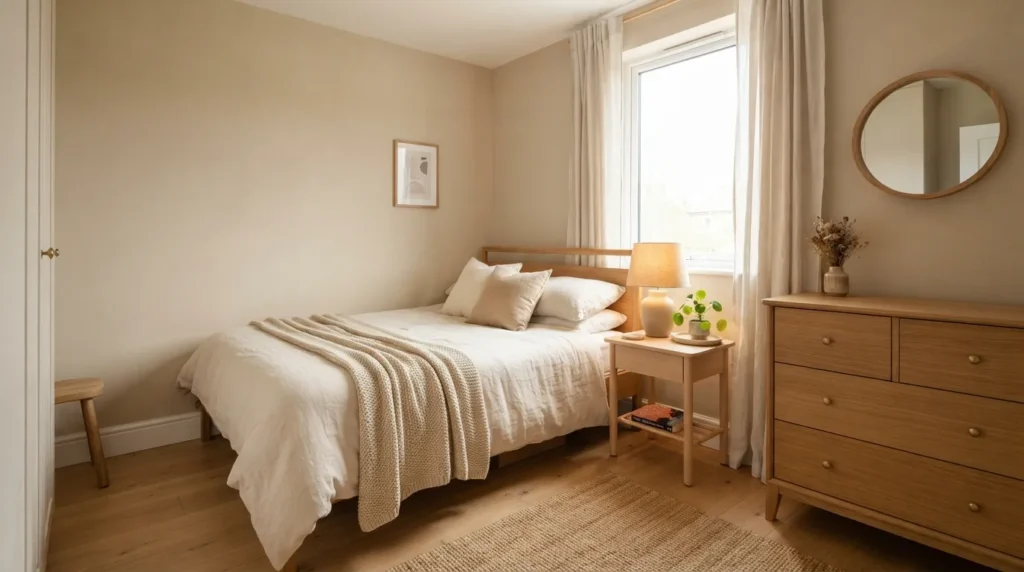
Leave some empty space on every major surface.
That breathing room makes the room feel more intentional.
How To Style It
Clear one surface completely.
Clean it.
Then return only the items you genuinely use or enjoy seeing.
On a nightstand, this might mean a lamp, book, and water glass.
On a dresser, it could be a mirror, small tray, and one decorative object.
Keep chargers, paperwork, and miscellaneous items contained whenever possible.
If you haven’t used an object recently, question whether it deserves permanent space.
The less visual competition you create, the larger the room can feel.
9. Repurpose Containers
Quick Benefits
- Saves money
- Keeps small items contained
- Gives existing objects another purpose
- Creates categories
- Makes hidden storage more efficient
Why It Works
Organization doesn’t always require purpose-made storage products.
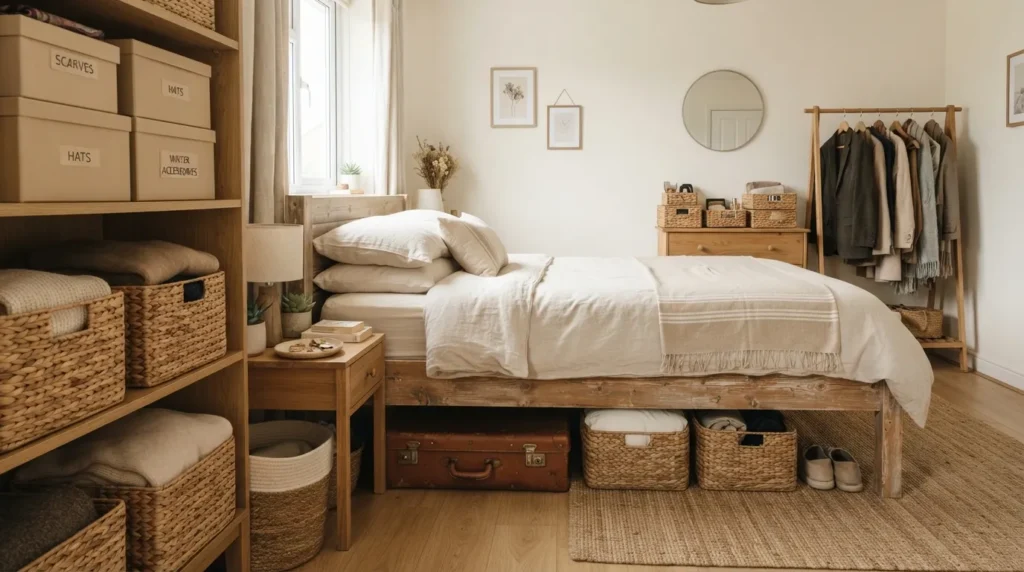
Shoeboxes, gift boxes, baskets, small bags, luggage, jars, and containers you already own can often hold everyday belongings.
The important thing is choosing containers that fit the category rather than collecting containers simply because they’re available.
A box can hold cables.
A small dish can hold jewelry.
A basket can contain scarves.
A suitcase can store seasonal clothing.
Repurposing what you already have is particularly useful when you’re trying to organize without adding furniture.
How To Style It
Walk through your home and identify unused containers before purchasing anything.
Group similar items together.
Use boxes inside drawers to create simple compartments.
Place smaller accessories inside existing pouches.
Use baskets on closet shelves if you already own them.
Label hidden containers if their contents aren’t obvious.
Keep visible containers visually coordinated when possible.
The objective is function first, but a consistent appearance can make the room feel calmer.
10. Maintain Daily Order
Quick Benefits
- Prevents clutter buildup
- Makes organization easier
- Reduces weekend cleaning
- Keeps systems practical
- Protects newly created space
Why It Works
Organizing a bedroom once isn’t enough.
The system needs to be simple enough to maintain during busy weeks.
If putting something away requires five steps, you’ll eventually leave it on the floor.
The best systems make the correct action easy.
A laundry basket should be accessible.
Everyday clothing should have a convenient home.
Frequently used accessories should be easy to reach.
Items used only occasionally can be stored farther away.
Small daily habits prevent clutter from becoming another large project.
How To Style It
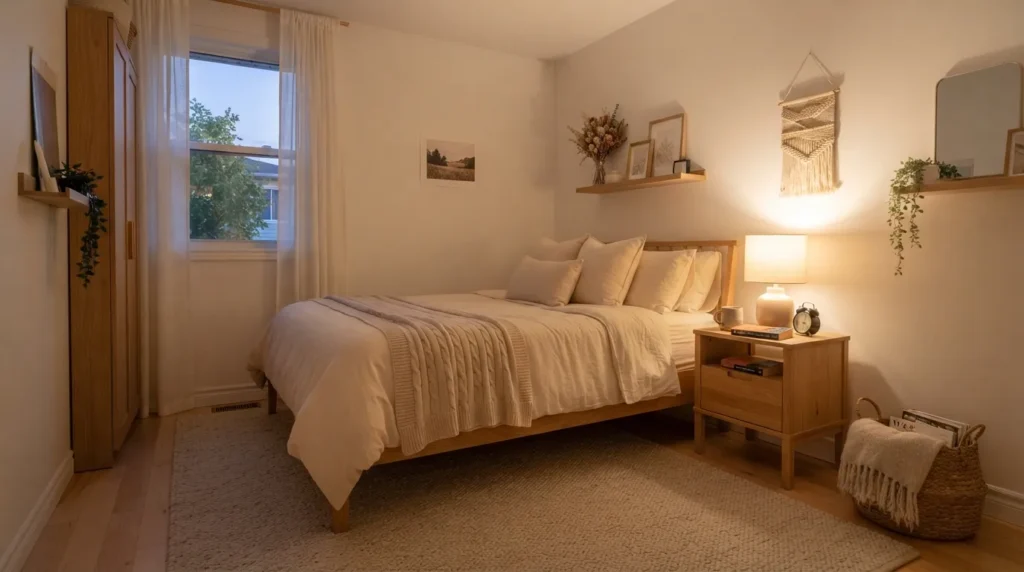
Create a five-minute evening reset.
Return clothing to its proper location.
Clear the floor.
Put books back where they belong.
Return small accessories to their containers.
Straighten the bed.
Once a week, check the surfaces and closet.
If something repeatedly ends up in the same wrong place, don’t simply keep moving it back.
Ask why.
The item may need a more convenient home.
A good organization system adapts to how you actually live.
How to Organize a Small Bedroom for Maximum Space
Once you’ve worked through the ten ideas, use this simple order to tackle the room.
Step 1: Clear the Floor
Remove laundry, shoes, bags, boxes, and anything that doesn’t belong.
Step 2: Declutter
Work through clothing and belongings one category at a time.
Step 3: Reposition Furniture
Experiment with the bed, dresser, desk, and chair.
Step 4: Identify Hidden Space
Look under the bed, above the closet, behind doors, and inside luggage.
Step 5: Create Zones
Give clothing, accessories, books, electronics, and personal items specific homes.
Step 6: Simplify Surfaces
Keep only useful or meaningful objects visible.
Step 7: Label Hidden Storage
Make it easy to remember what’s stored where.
Step 8: Create a Reset Routine
Spend a few minutes each day returning things to their designated locations.
This sequence prevents you from trying to organize clutter before determining what actually belongs in the room.
Small Bedroom Organization Ideas for Renters
Renting doesn’t mean you have to live with constant clutter.
Focus on solutions that don’t require permanent construction.
Use removable hooks when appropriate and within their weight limits.
Repurpose existing baskets and containers.
Use luggage as hidden seasonal storage.
Take advantage of under-bed space.
Keep the closet organized by category.
Use furniture surfaces more intentionally.
If your lease allows temporary wall solutions, use products designed for the relevant surface and follow their installation instructions carefully.
Before installing anything, check your lease and understand what changes are permitted.
Small Bedroom Organization Ideas Without Spending Money
You can make meaningful improvements before buying a single organizing product.
Rearrange the furniture.
Declutter clothing.
Use your suitcase for seasonal storage.
Fold bulky items more efficiently.
Move rarely used belongings out of prime-access areas.
Repurpose boxes and baskets.
Clear your nightstand.
Use the back of the door.
Create a dedicated laundry location.
Set up a five-minute evening reset.
The best first step is usually editing rather than shopping.
Common Small Bedroom Organization Mistakes
Keeping Too Much Clothing
Limited storage becomes overwhelmed quickly when every season’s wardrobe remains equally accessible.
Using the Floor as Storage
The floor is valuable circulation space, not a permanent storage zone.
Ignoring Vertical Areas
Walls and door surfaces can provide useful organization when used thoughtfully.
Overfilling Containers
A container that’s difficult to open or sort through isn’t solving the problem.
Creating Complicated Systems
If an organization method takes too much effort, it may not survive a busy week.
Buying Before Decluttering
New containers don’t create meaningful space if unnecessary belongings remain.
Forgetting Daily Habits
A room can be perfectly organized today and cluttered again next week without a simple maintenance routine.
Frequently Asked Questions
How can I organize a small bedroom without buying furniture?
Start by decluttering, rearranging existing furniture, using under-bed space, organizing the closet more efficiently, and taking advantage of doors and vertical areas. Repurpose containers you already own for smaller belongings. Reducing unnecessary items can create more usable space without adding another storage unit.
How do I make a small bedroom feel less cluttered?
Clear the floor, reduce visible objects, keep surfaces partially empty, and group belongings into defined categories. Use hidden storage beneath the bed or inside existing furniture. A consistent home for everyday items also prevents small piles from developing.
Where should I put clothes in a small bedroom?
Use the existing closet and dresser as efficiently as possible. Keep frequently worn clothes within easy reach and place seasonal or rarely used items in less accessible areas. Suitcases, existing boxes, and under-bed storage can hold soft seasonal items when appropriate.
How can I organize clothes without a dresser?
Use your closet, existing shelves, under-bed storage, baskets, boxes, or luggage. Fold suitable clothing rather than hanging everything, and create clear categories. If you have limited hanging space, prioritize garments that benefit most from hanging and fold the rest.
How do I use vertical space in a small bedroom?
Use suitable hooks, existing wall organizers, pegboards, hanging solutions, and the back of the door for lightweight belongings. Keep frequently used items accessible and avoid overloading walls. For rental properties, use solutions permitted by your lease and appropriate for the surface.
What should I store under my bed?
Under-bed space works well for seasonal clothing, spare bedding, luggage, shoes, and other items that aren’t needed every day. Use suitable containers or bags and group similar belongings together. Avoid storing items that could be damaged by dust or moisture.
How do I keep a small bedroom organized every day?
Create a short daily reset. Put clothes away, clear the floor, return books and accessories to their homes, and straighten the bed. If an item repeatedly gets left in the same place, reconsider where it is stored and make its designated home more convenient.
Conclusion
Organizing a small bedroom without buying furniture starts with a simple shift in perspective.
Instead of asking what storage unit you need, look at what space you already have.
The area beneath the bed may hold seasonal clothing. The back of the door can organize bags and accessories. A closet may have unused vertical space. A suitcase can become hidden storage. Even a clear nightstand can make the entire room feel more spacious.
Decluttering is the foundation.
Once unnecessary belongings are removed, rearrange the furniture and create simple zones for everything that remains. Keep everyday items convenient, store occasional belongings farther away, and use containers you already own to keep smaller categories together.
Most importantly, create a system that matches your actual habits.
A bedroom doesn’t stay organized because every object has a perfect Pinterest-worthy container. It stays organized because putting things away is easy enough to become part of everyday life.
Start with one corner today.
Clear it, decide what belongs there, and give the remaining items a specific home. Then move to the next area.
You may be surprised by how much space appears when you stop trying to fit more into the room and start making better use of what you already have.
Related Articles
- How to Make a Small Bedroom Feel Bigger With Simple Changes
- 10 Small Bedroom Organization Ideas for Maximum Space
- How to Decorate a Small Bedroom Without Spending a Fortune
- 10 Minimal Aesthetic Bedroom Ideas for Adults
- How to Make a Small Bedroom Feel Bright With Natural Light