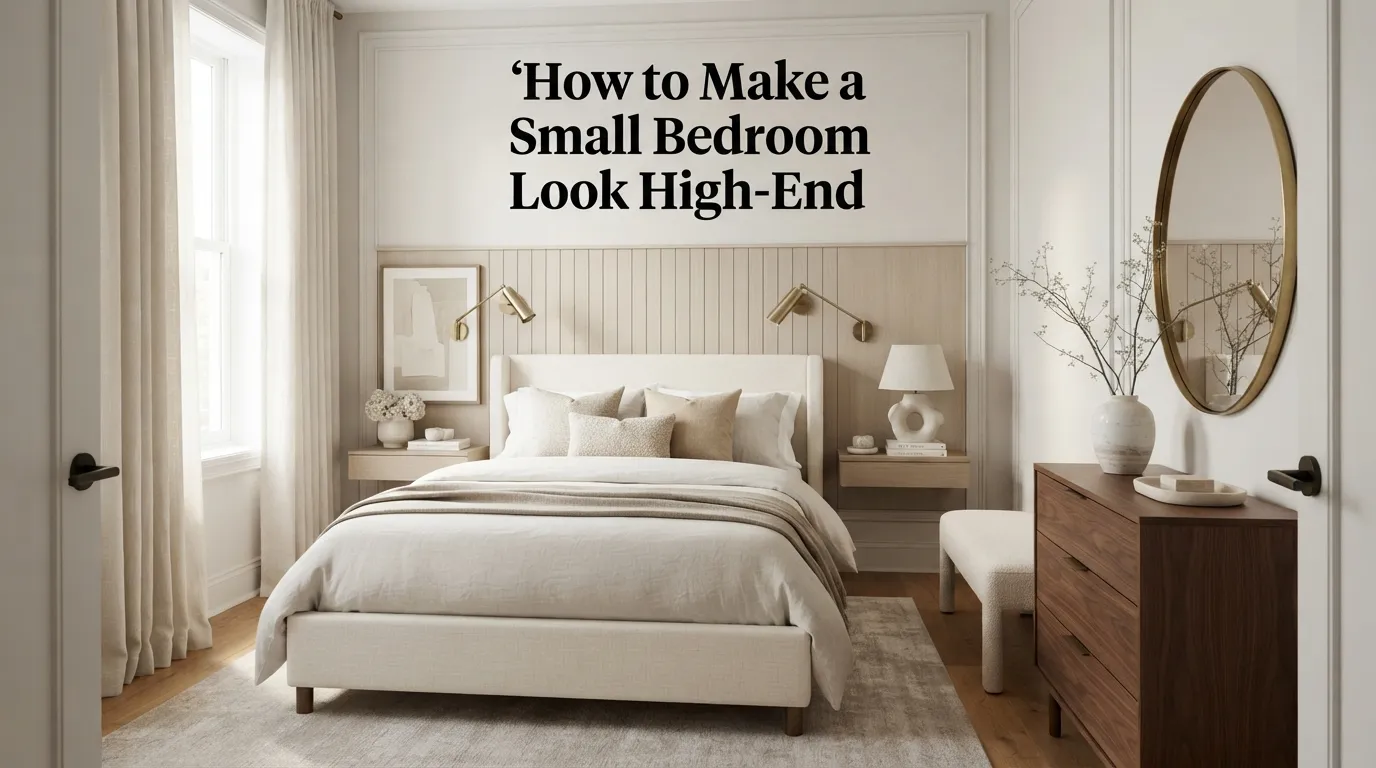
How to Make a Small Bedroom Look High-End
A small bedroom can look polished and expensive without having a large footprint or a luxury-sized decorating budget. In fact, working with less space can make it easier to create a cohesive room because every furniture piece, textile, and decorative detail has a visible role.
The secret is not filling the room with expensive-looking accessories. It’s creating a sense of intention.
High-end bedrooms usually share a few characteristics: a restrained color palette, balanced furniture placement, quality-looking textiles, layered lighting, thoughtful artwork, and very little visual clutter. These principles can work just as well in a compact bedroom as they do in a spacious primary suite.
In my experience, textiles often create the biggest transformation. A well-made-looking duvet, full-length curtains, a properly sized rug, and a few substantial pillows can make basic furniture feel considerably more refined. Lighting is another major factor. A harsh ceiling fixture can flatten an otherwise beautiful room, while warm bedside lighting immediately adds atmosphere.
You also don’t have to replace everything you own. A simple wood nightstand can look sophisticated when styled carefully. An inexpensive mirror can become a focal point when positioned correctly. Even rearranging furniture to create better symmetry can make the room feel more considered.
The ideas below focus on realistic ways to make a compact bedroom feel elegant, comfortable, and elevated. Some involve shopping, while others rely entirely on editing, rearranging, or restyling what you already have.
Whether you’re decorating a small apartment bedroom, guest room, rental, or primary bedroom, these approaches can help you create a space that feels luxurious without sacrificing practicality.
Table of Contents
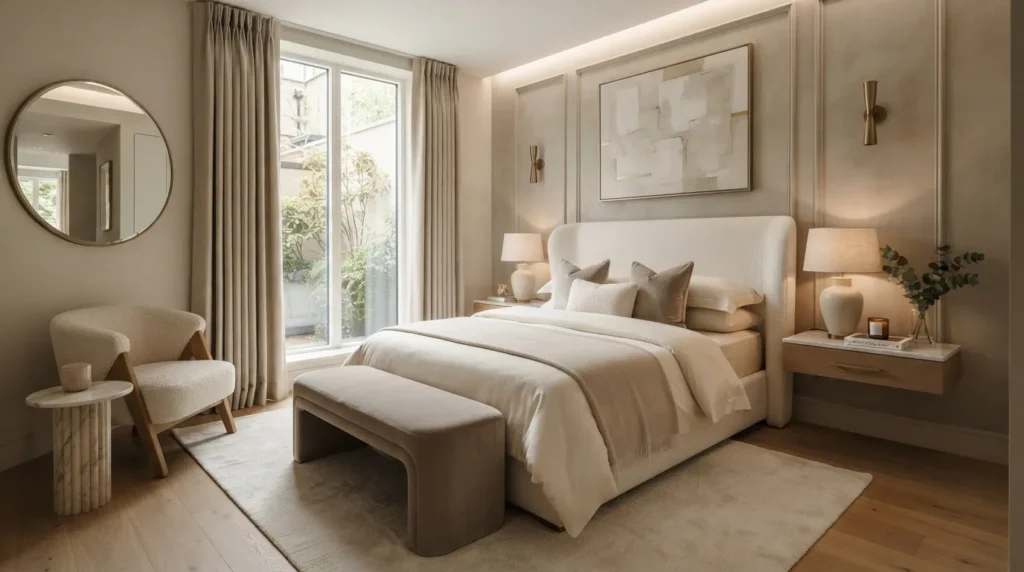
1. Choose a Refined Palette
Create an elegant foundation with a limited group of sophisticated colors.
2. Upgrade the Bedding
Use layered textiles to make the bed look comfortable and substantial.
3. Create Symmetry
Use balanced furniture and decor placement to create a polished appearance.
4. Add Full-Length Curtains
Use generous window treatments to add height and softness.
5. Layer the Lighting
Combine multiple light sources for a warm, sophisticated atmosphere.
6. Choose One Statement Piece
Give the small room a memorable focal point without overcrowding it.
7. Use Oversized Artwork
Make a compact bedroom feel intentional with one substantial art piece.
8. Introduce Metallic Details
Add restrained touches of brass, bronze, or another complementary finish.
9. Edit the Decor
Remove visual clutter so the most beautiful details receive attention.
10. Finish With Texture
Use natural and tactile materials to create depth and comfort.
1. Choose a Refined Palette
Quick Benefits
- Creates visual cohesion
- Makes the room feel sophisticated
- Helps a small space feel calmer
- Makes furniture easier to coordinate
- Provides a timeless foundation
Why It Works
Color has a major influence on how a small bedroom feels.
A room filled with too many competing colors can look visually busy, especially when there isn’t much space between furniture pieces.
A restrained palette creates continuity.
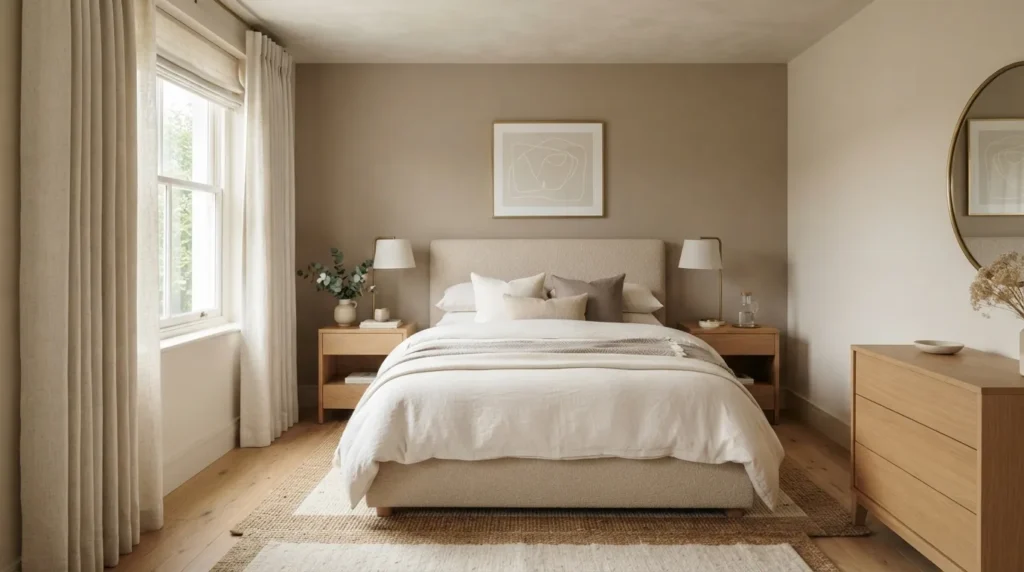
Warm white, ivory, taupe, beige, mushroom, soft gray, muted sage, and deep brown can all contribute to an elevated bedroom when combined thoughtfully.
The goal isn’t necessarily an all-white room.
Instead, choose one dominant neutral and two or three supporting shades. Then repeat those colors through bedding, curtains, artwork, rugs, and accessories.
This repetition makes the room feel designed rather than randomly decorated.
How To Style It
Start with the largest elements.
Choose a wall color, bedding shade, and curtain color that work together.
For example, warm white walls can pair with oatmeal bedding, beige curtains, natural wood, and small touches of dark brown.
If you prefer more contrast, use charcoal or espresso in small doses.
Avoid introducing a new accent color every time you add an accessory.
Repeat existing shades instead.
For a small bedroom, keeping the ceiling and larger visual planes relatively light can also help preserve an airy appearance.
2. Upgrade the Bedding
Quick Benefits
- Creates an immediate focal point
- Adds softness and depth
- Makes the bed look more substantial
- Introduces sophisticated texture
- Improves everyday comfort
Why It Works
The bed is usually the largest object in a bedroom, so its appearance has an outsized effect on the entire room.
You don’t necessarily need designer bedding.
What matters most is layering.
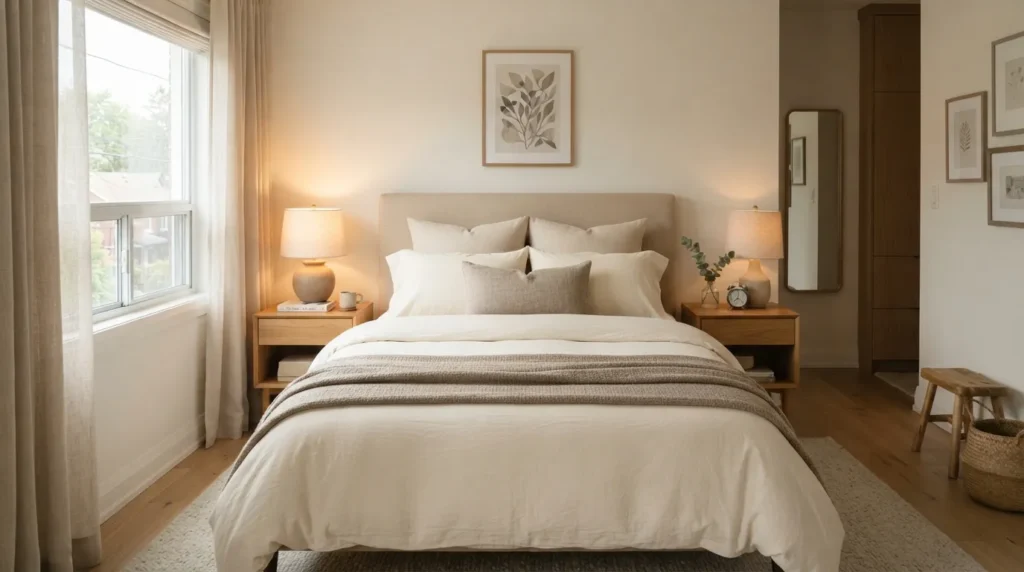
A single flat comforter can make the bed look unfinished, while a duvet, neatly arranged pillows, and a folded throw create depth.
High-end bedrooms also tend to avoid excessive decorative pillows.
A smaller number of substantial layers often looks more polished than a crowded arrangement.
How To Style It
Start with neutral sheets and a duvet or quilt.
Add two sleeping pillows and one or two decorative layers in complementary shades.
Fold a textured throw across the bottom third of the bed.
Choose fabrics with subtle texture, such as linen, cotton, quilted materials, or velvet accents.
Make sure the bedding fits the bed properly.
A duvet that’s too small or a comforter that barely reaches the sides can make the entire arrangement look less polished.
Keep patterns understated.
If you want visual interest, let texture rather than bold prints provide it.
3. Create Symmetry
Quick Benefits
- Makes the room look intentional
- Creates visual balance
- Works well in compact spaces
- Makes inexpensive furniture feel more polished
- Simplifies decorating decisions
Why It Works
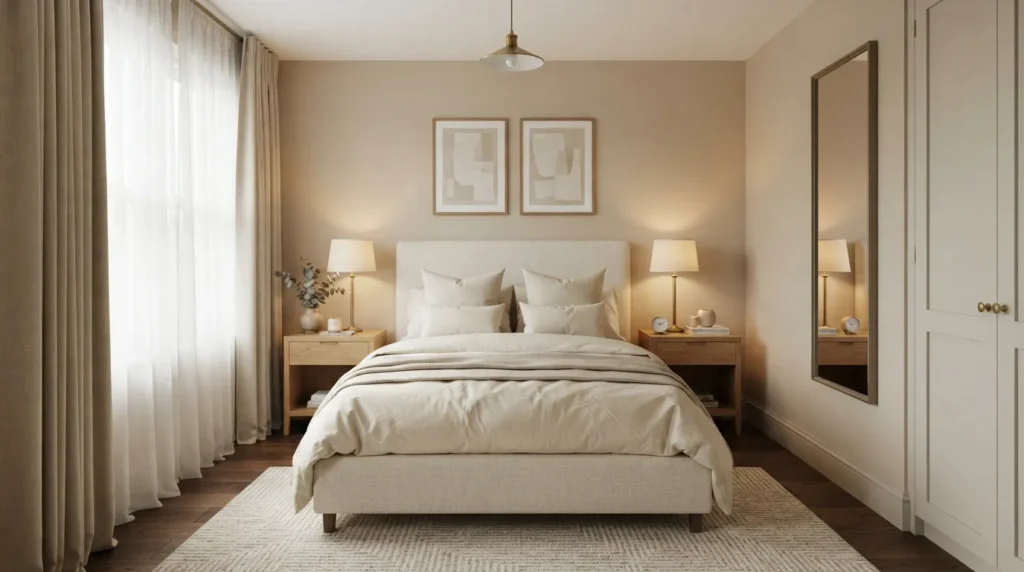
Symmetry is one of the easiest design principles to use when you want a bedroom to feel more sophisticated.
Matching nightstands and lamps on either side of the bed create an instant sense of order.
Even when the furniture isn’t identical, similar visual weight can produce a balanced composition.
This matters especially in a small bedroom because there isn’t much space for decorative distractions.
A balanced arrangement allows the eye to understand the room quickly.
It also gives the bed a strong focal position.
How To Style It
If space permits, place a nightstand on each side of the bed.
Use matching lamps or lamps with similar proportions.
Keep the styling relatively simple.
For example, one side might have a small vase while the other has a book, as long as the overall visual weight remains balanced.
If you only have room for one nightstand, don’t force symmetry.
Instead, create intentional asymmetry by balancing the other side with artwork, a floor lamp, or another visually substantial element.
The goal is balance, not identical objects.
4. Add Full-Length Curtains
Quick Benefits
- Makes ceilings appear taller
- Softens hard surfaces
- Adds texture
- Creates a more finished appearance
- Enhances natural light
Why It Works
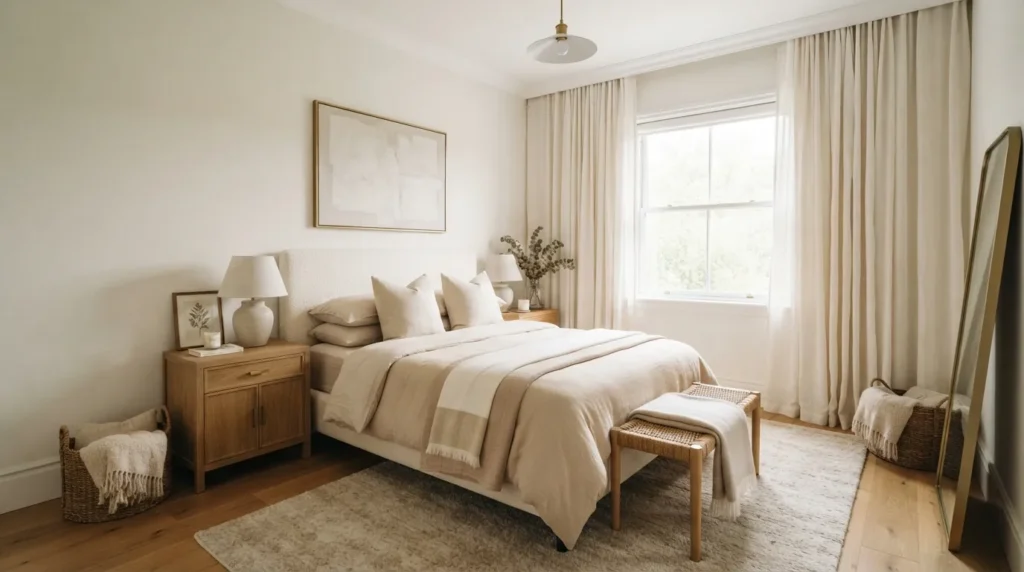
Curtains can make a surprisingly significant difference in a small bedroom.
Short or poorly positioned curtains can emphasize the size of a window, while long panels create stronger vertical lines.
Hanging curtains closer to the ceiling and allowing them to extend toward the floor can make the entire wall feel taller.
The fabric also adds softness.
This is particularly useful when a bedroom contains many hard surfaces such as wood furniture, mirrors, and painted walls.
How To Style It
Choose curtains in a color close to the walls if you want a seamless appearance.
Warm white, ivory, beige, oatmeal, and soft gray are versatile options.
Install the rod high enough to emphasize the room’s vertical dimensions while accounting for the window and existing trim.
Extend the rod beyond the window where appropriate so the curtains don’t unnecessarily block natural light when open.
Choose enough fabric for a full appearance.
Avoid extremely thin panels that look sparse when closed.
For a more luxurious effect, combine privacy or light-filtering curtains with another appropriate window treatment if needed.
5. Layer the Lighting
Quick Benefits
- Creates warmth
- Adds visual depth
- Makes the bedroom feel more luxurious
- Supports different activities
- Reduces reliance on harsh overhead lighting
Why It Works
Lighting can be the difference between a basic bedroom and one that feels like a boutique hotel.
One ceiling fixture rarely provides the atmosphere you want for reading, relaxing, getting dressed, or winding down.
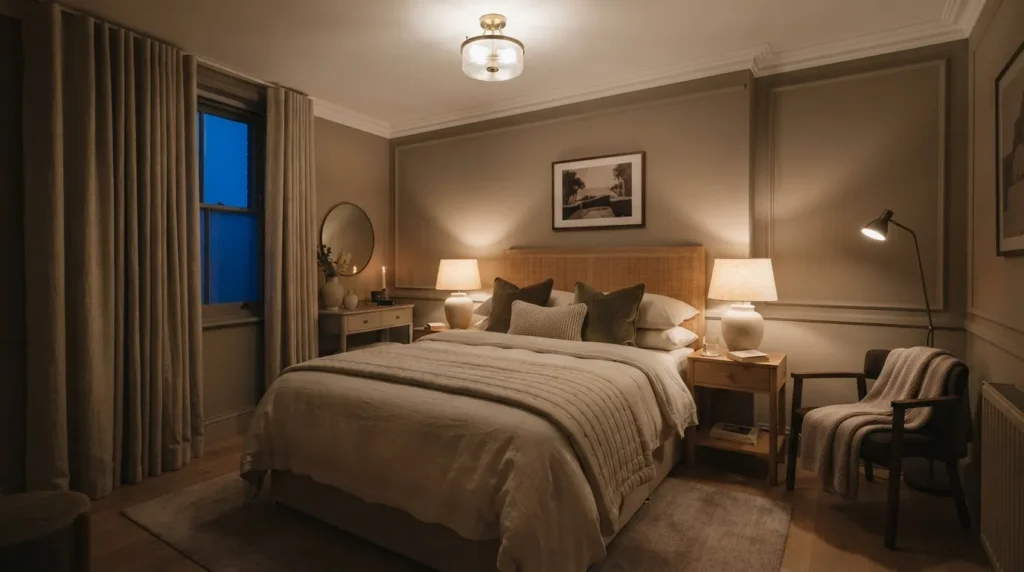
Layered lighting gives the room several levels of illumination.
Bedside lamps create a comfortable glow.
A floor lamp can illuminate a darker corner.
Wall sconces can add architectural interest while preserving nightstand space.
Natural daylight provides another important layer during the day.
How To Style It
Start with bedside lighting.
Choose fixtures with proportions appropriate for your nightstands and bed.
Use warm-toned bulbs suitable for the fixtures.
If your ceiling fixture is visually dominant, consider replacing it with a simpler fixture that complements the room.
A small floor lamp can work beautifully in an empty corner.
For a compact room, wall-mounted lighting can preserve valuable surface area.
Keep the finishes consistent.
If you choose brass bedside lamps, repeat a small amount of brass elsewhere rather than introducing several unrelated metals.
6. Choose One Statement Piece
Quick Benefits
- Creates a focal point
- Prevents visual clutter
- Makes the room memorable
- Gives inexpensive pieces more presence
- Simplifies the design
Why It Works
A common mistake in small bedrooms is trying to make every item special.
The result can be a room where multiple accessories compete for attention.
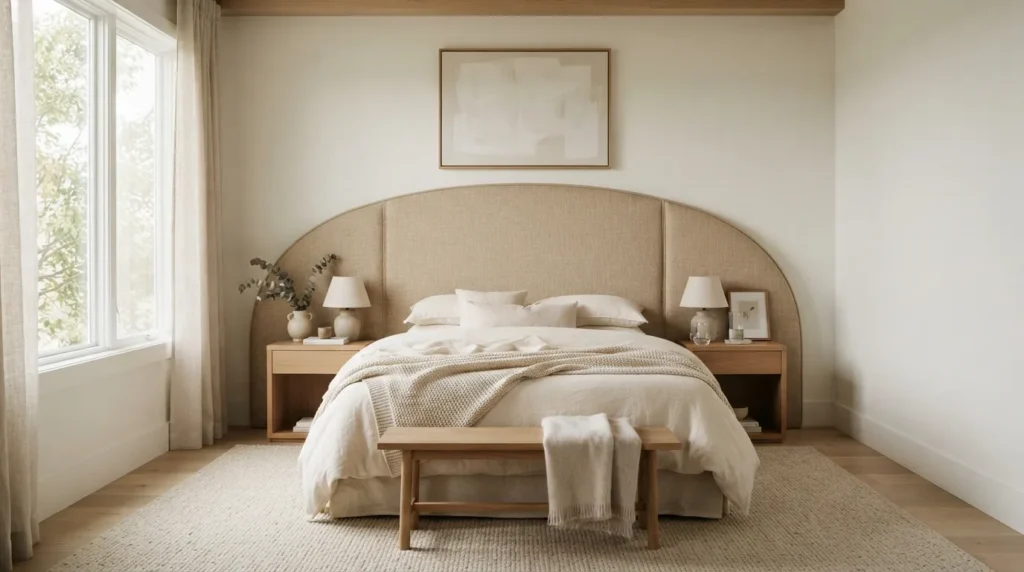
Instead, choose one primary statement piece.
This could be a beautiful headboard, large mirror, sculptural light fixture, substantial artwork, upholstered bench, or distinctive vintage piece.
Once you’ve chosen the focal point, keep the surrounding elements relatively quiet.
This creates contrast and makes the statement piece feel more valuable.
How To Style It
Look at the room’s existing architecture.
If the bed wall is plain, a tall upholstered headboard can become the focal point.
If the bed already has a strong silhouette, a large piece of artwork may be enough.
For a narrow bedroom, a statement mirror can add visual interest while reflecting light.
Avoid placing several oversized pieces in the same small room.
Choose one and let it breathe.
The surrounding negative space is part of what makes a focal point effective.
7. Use Oversized Artwork
Quick Benefits
- Creates visual impact
- Reduces the need for multiple small decorations
- Gives walls a finished appearance
- Makes the room feel curated
- Can visually anchor the bed
Why It Works
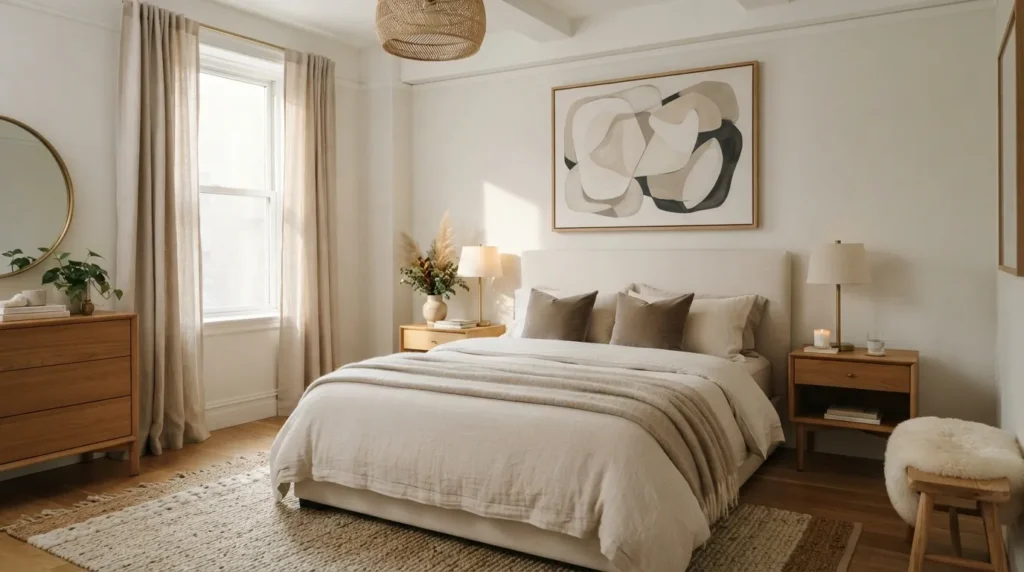
Small rooms don’t always benefit from lots of tiny artwork.
A collection of small frames can make a wall feel fragmented.
One larger piece often creates a stronger visual statement with less clutter.
Abstract art, photography, botanical prints, textured canvas, and restrained line drawings can all work depending on your decorating style.
The artwork doesn’t need to be expensive.
Its scale, frame, colors, and relationship to the surrounding furniture are more important.
How To Style It
Choose artwork that repeats at least one color already present in the bedroom.
Position it where it naturally relates to the furniture.
Above the bed is an obvious option, provided the dimensions and mounting are appropriate.
A large piece on an adjacent wall can work just as well.
Use a simple frame that complements your furniture finishes.
Avoid selecting artwork solely because it matches the wall color.
Some subtle contrast helps the piece stand out.
8. Introduce Metallic Details
Quick Benefits
- Adds subtle elegance
- Creates visual contrast
- Enhances lighting
- Works with neutral palettes
- Makes simple furniture feel more finished
Why It Works
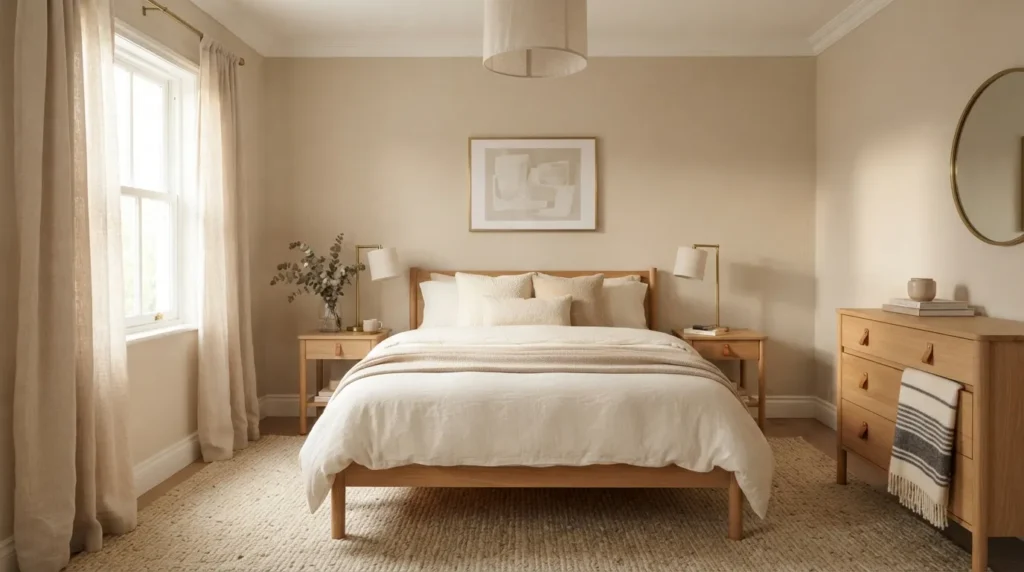
Metallic finishes can add a refined touch without requiring major changes.
Brass, brushed brass, bronze, nickel, and blackened metal each create a different mood.
Warm metals pair particularly well with cream, beige, taupe, and natural wood.
Cooler metals can complement gray, white, and contemporary interiors.
The important part is restraint.
A few repeated metal details look intentional.
Too many finishes can make a small room feel visually chaotic.
How To Style It
Choose one dominant metal finish.
Use it on lamp bases, picture frames, drawer pulls, curtain hardware, or a small decorative object.
You don’t need every metal element to match perfectly.
However, keeping the majority within the same general finish family creates cohesion.
For a warm bedroom, brushed brass can look beautiful against ivory and wood.
For a contemporary room, black metal can create sharper contrast.
Use metallic finishes as accents rather than the main design element.
9. Edit the Decor
Quick Benefits
- Makes the room feel larger
- Highlights important pieces
- Reduces visual noise
- Makes cleaning easier
- Creates a curated appearance
Why It Works
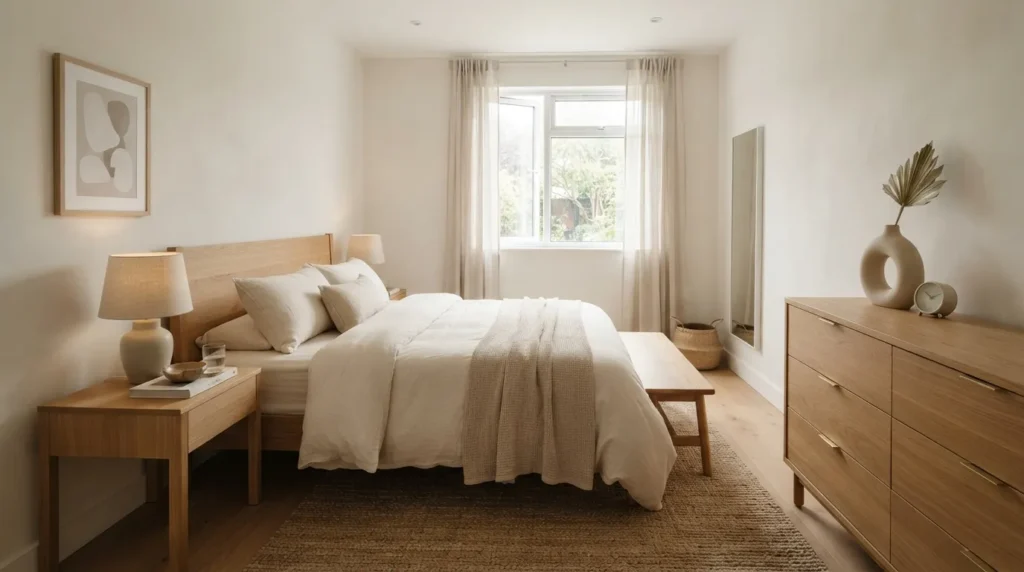
Luxury isn’t always about adding more.
Often, it comes from having enough space around the things you choose to display.
A crowded nightstand can make a beautiful lamp look ordinary.
A dresser covered with accessories can make an elegant mirror disappear into the background.
Editing allows each piece to have more visual importance.
This is particularly valuable in a small bedroom where every surface is close to another.
How To Style It
Start by removing everything from your dresser and nightstands.
Clean the surfaces.
Then return only the pieces that are useful, meaningful, or genuinely attractive.
Try grouping small objects together on a tray rather than scattering them.
Keep decorative arrangements at different heights.
Leave some empty space.
If you’re unsure whether an item belongs, remove it temporarily and see whether the room feels better without it.
Often, the answer becomes obvious once the visual noise is gone.
10. Finish With Texture
Quick Benefits
- Adds depth
- Makes neutral rooms feel richer
- Creates comfort
- Prevents a minimalist look from becoming cold
- Adds visual interest without clutter
Why It Works
A sophisticated bedroom doesn’t have to rely on bold colors.
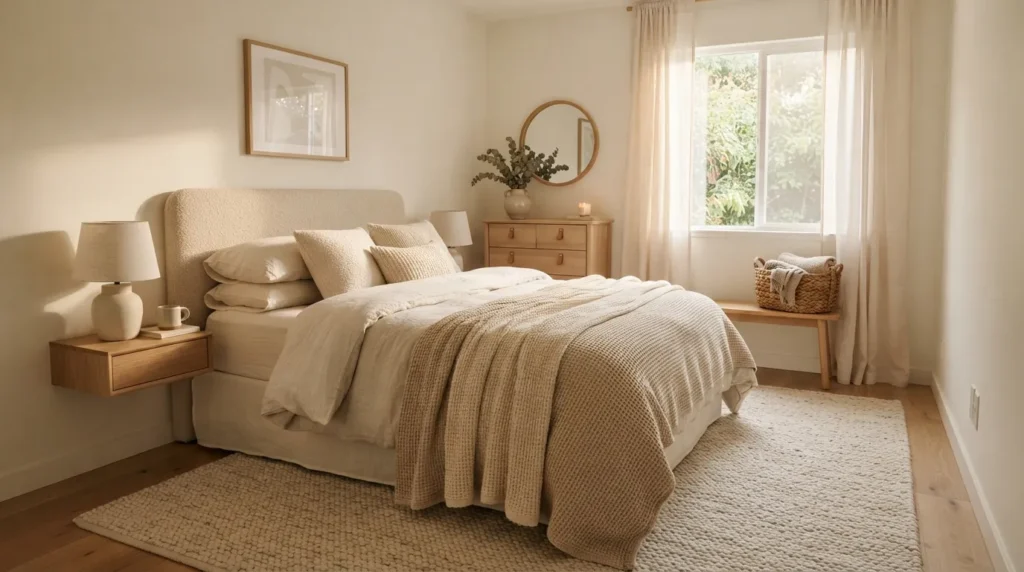
Texture can provide much of the visual richness instead.
Think linen bedding, woven baskets, wool-style rugs, wood grain, ceramic lamps, velvet cushions, boucle upholstery, or lightly textured curtains.
These materials catch light differently.
They create subtle variation even when the color palette remains restrained.
That makes the room feel layered without appearing busy.
How To Style It
Choose three or four primary textures.
For example, combine linen bedding, a wool-style rug, natural wood furniture, and a ceramic lamp.
Keep the colors relatively close.
If everything is beige but every surface is smooth, the room may look flat.
If the same palette includes rough, woven, soft, matte, and polished surfaces, it becomes much more interesting.
Let texture appear naturally through useful objects rather than adding decorative pieces simply for the sake of variety.
How to Make a Small Bedroom Look Expensive on a Budget
You don’t need to replace the entire bedroom to create a more elevated appearance.
Start with the elements that occupy the most visual space.
Make the Bed the Focal Point
Invest in or improve the bedding before buying lots of small accessories.
Use Larger Pieces Carefully
One substantial artwork or mirror can look more sophisticated than a wall full of tiny decorations.
Upgrade the Lighting
A beautiful lamp can have more impact than several inexpensive decorative objects.
Create Symmetry
Matching or visually balanced nightstands and lamps instantly make a room feel more considered.
Keep Surfaces Clear
Editing is free and often has a surprisingly large impact.
Use Curtains Correctly
Long, well-proportioned curtains can make a compact room feel taller and softer.
Repeat Finishes
If you use wood, brass, or black metal, repeat that finish subtly around the room.
Shop Your Home
Move artwork, lamps, baskets, throws, or mirrors from another room before purchasing anything new.
The most convincing high-end rooms aren’t necessarily the ones with the most expensive objects. They’re the ones where everything feels like it belongs together.
Small Bedroom Color Combinations That Look Elegant
A sophisticated color palette doesn’t need to be complicated.
Warm White + Oatmeal + Oak
Soft, natural, and timeless.
Cream + Taupe + Brass
Warm with a subtle polished finish.
Beige + Chocolate Brown + Ivory
Rich without becoming dark.
Soft Gray + White + Natural Wood
Clean and contemporary.
Ivory + Muted Sage + Brass
Fresh and quietly elegant.
Warm White + Charcoal + Walnut
Higher contrast with a modern feel.
Choose one dominant color, one supporting neutral, and one accent.
Then repeat them consistently.
Small Bedroom Furniture Placement Tips
Furniture arrangement can make the same room feel either cramped or surprisingly spacious.
Start with the bed because it usually occupies the largest amount of floor area.
Where possible, position it so the primary walking path remains clear.
Avoid placing furniture where drawers or closet doors cannot open fully.
Keep bedside tables proportional to the bed.
If the room is narrow, avoid filling both sides with bulky furniture.
Consider whether a dresser is blocking natural light.
If you have a chair that rarely gets used but frequently becomes a clothing pile, either relocate it or give it a specific function.
One useful rule is to preserve visible floor area wherever possible.
Seeing more uninterrupted floor can make a compact bedroom feel more spacious.
What Makes a Bedroom Look Cheap?
A bedroom doesn’t look inexpensive simply because the furniture isn’t expensive.
Several styling choices can make any room feel less polished.
Too Many Small Accessories
Lots of tiny decorative objects can create visual noise.
Poorly Fitting Bedding
A duvet that’s too small or sheets that constantly come untucked can make the bed look unfinished.
Mismatched Color Choices
Too many unrelated accent colors can prevent the room from feeling cohesive.
Harsh Lighting
Very bright or cool lighting can make warm materials look flat.
Furniture Overcrowding
Too many pieces reduce both usable floor space and visual breathing room.
Excessive Matching
A bedroom where every item comes from the same set can sometimes feel less collected and personal.
Cluttered Surfaces
Even beautiful objects lose impact when packed together.
The solution isn’t necessarily buying better things.
Often, it’s editing, rearranging, and improving proportions.
Frequently Asked Questions
How can I make a small bedroom look expensive?
Focus on a cohesive color palette, well-layered bedding, balanced furniture placement, warm lighting, full-length curtains, and limited decor. One substantial focal point, such as artwork, a headboard, or mirror, can also make the room feel more intentional. You don’t need expensive furniture if the overall composition is thoughtful.
What colors make a small bedroom look luxurious?
Warm white, cream, taupe, beige, soft gray, muted sage, walnut brown, and restrained charcoal can all create an elegant atmosphere. The key is limiting the number of colors and repeating them throughout the room. A small amount of brass or another coordinated metal can provide subtle contrast.
How do I make a small bedroom look like a hotel room?
Create a strong focal point around the bed, use layered neutral bedding, install warm bedside lighting, keep surfaces uncluttered, and use curtains that frame the windows elegantly. Symmetry can also help create the polished appearance associated with many hotel rooms.
Does dark furniture make a small bedroom look smaller?
Not necessarily. Dark furniture creates more visual weight, but it can work beautifully when balanced with lighter walls, bedding, curtains, and flooring. The amount of dark furniture matters. One walnut dresser can provide attractive contrast without making the entire room feel heavy.
What lighting makes a bedroom look more luxurious?
Layered warm lighting generally creates a more inviting atmosphere than relying on one overhead fixture. Combine bedside lamps with natural daylight and, where appropriate, a floor lamp or wall-mounted light. Choose bulbs and fixtures that produce the type of warmth and brightness appropriate for your evening routine.
How many decorative pillows should a small bedroom have?
There isn’t a strict number, but fewer substantial pillows often look more polished than a bed crowded with small cushions. Keep enough pillows for comfort and one or two decorative layers if desired. Leave visible bedding around them so the bed retains a clean, intentional appearance.
Can a rental bedroom look high-end?
Yes. Focus on reversible changes such as bedding, lighting, curtains, artwork, mirrors, rugs, furniture arrangement, and decor editing. Before installing or altering anything, check your lease and use appropriate solutions for the property. Many of the most effective changes don’t involve permanent renovations.
Conclusion
Making a small bedroom look high-end isn’t about squeezing luxury into every available corner.
It’s about making deliberate choices.
Start with a refined palette and build from there. Give the bed a polished appearance with layered bedding. Create balance through furniture placement and symmetry. Use warm lighting, full-length curtains, natural textures, and one meaningful statement piece to add depth.
Most importantly, resist the temptation to fill the room.
A small bedroom often looks more sophisticated when there is space around the furniture and enough empty surface area for the eye to rest. One beautiful lamp can have more impact than five decorative objects. One oversized artwork can feel more intentional than a wall covered in small frames.
If you’re decorating on a budget, begin with the changes that cost little or nothing. Rearrange the furniture, remove unnecessary decor, restyle the bedding, improve the lighting, and shop your home for pieces that can be moved into the room.
Then make one or two carefully chosen upgrades.
The goal is a bedroom that feels elevated but still comfortable enough for everyday life.
With the right proportions, materials, lighting, and editing, even a compact bedroom can feel calm, polished, and distinctly personal.
Related Articles
- 10 Soft Minimal Aesthetic Bedroom Ideas
- How to Make a Small Bedroom Feel Bigger With Simple Changes
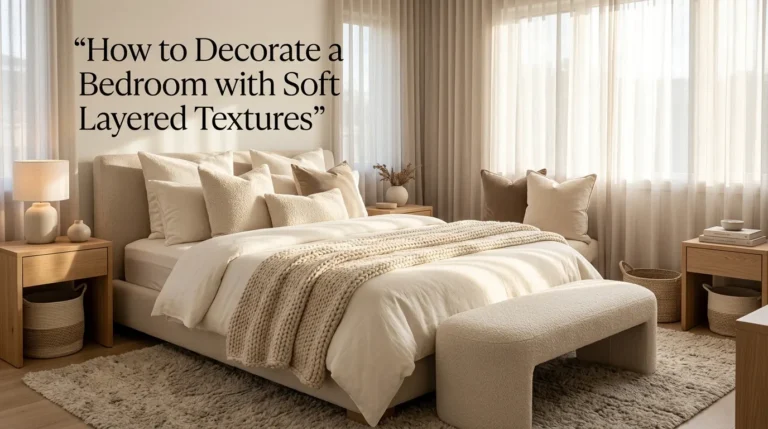
- How to Decorate a Bedroom With Soft Layered Textures
- 10 Modern Bedroom Ideas With Hotel-Inspired Decor
- How to Make a Small Bedroom Feel Bright With Natural Light